There’s a category of ranch problem that has no catalog solution: the gate opening that’s eleven feet where every gate sold is ten or twelve, the railing that has to follow a stone staircase nobody else built, the fifty-year-old implement whose broken part hasn’t been manufactured since the Nixon administration. That’s welding-crew territory, and on a working property, it comes up more often than almost any other trade.
Here’s what ranch welding actually covers, and how to think about custom fabrication versus buying off the shelf.
Custom gates: the flagship fabrication
Steel gates are where fabrication earns its keep most visibly:
- Fit: built to the actual opening, the actual grade, the actual hinge post, not the nearest stock size
- Duty: tube gauge, bracing, and hinge engineering matched to real use; a gate that meets a loaded stock trailer’s mirror or a bull’s shoulder is a different build than a garden gate
- Character: brands, silhouettes, and lettering cut into panels, the same work described in our ranch sign guide, plus automation-ready hardware for gate operators
A decorative steel entry gate fabricated for a Livingston-area entrance is in our project gallery, one build where fit, duty, and character all show at once.
Railings: where steel meets craft
Hand-fabricated railings solve what stock railing can’t: following site-built geometry. The forged railing on our flagstone staircase project (welded on-site, following massive stone slab steps up a hillside) is the clearest example in the gallery. Railings for decks, stairs, and porches get built to their exact runs, welded joints ground clean, and finished for outdoor life. When the geometry came from the land instead of a plan set, fabrication isn’t the premium option; it’s the only one.
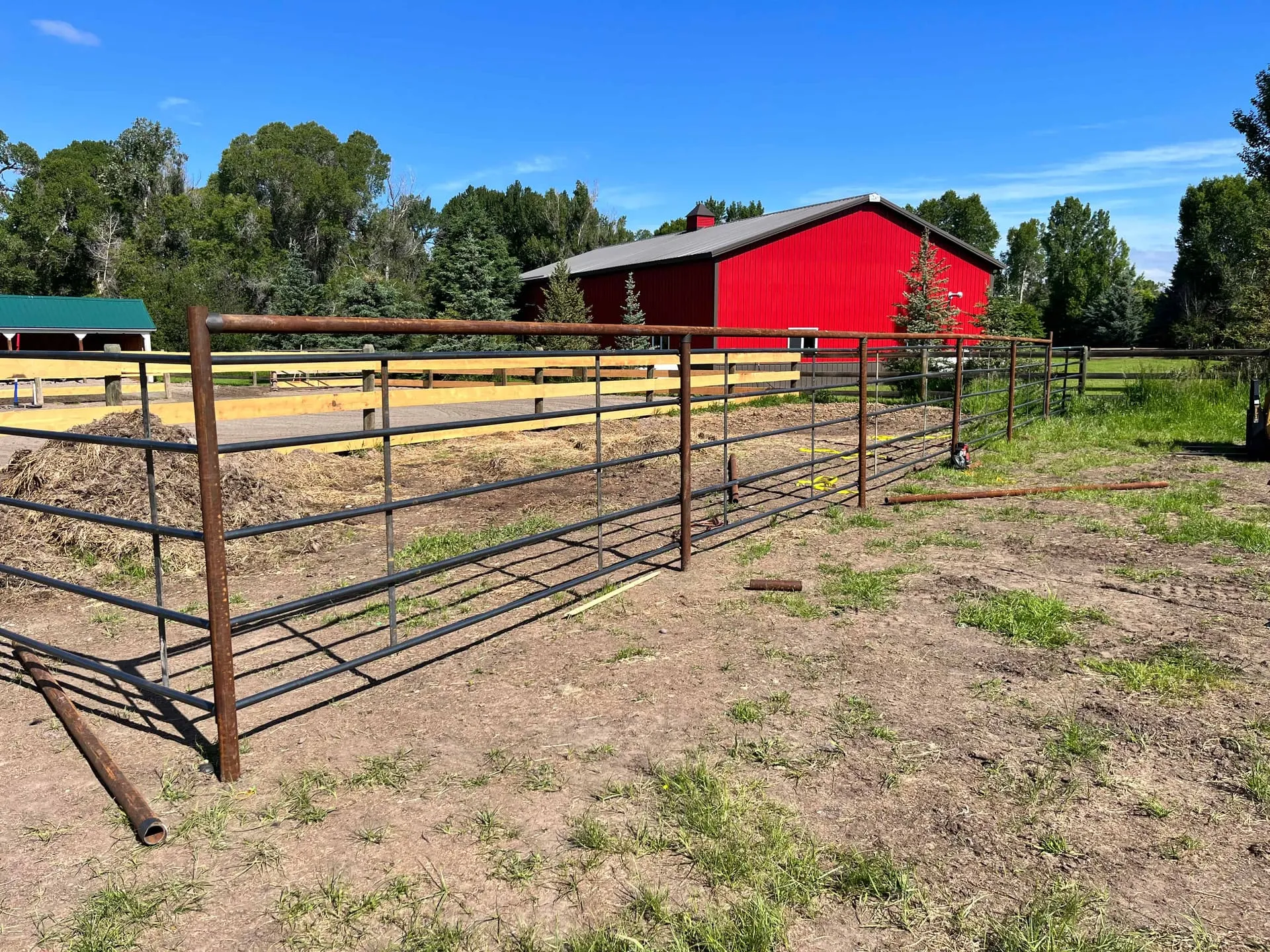 Welded panel corral from the gallery — the fabrication that takes daily stock pressure.
Repairs: the unglamorous majority
Most welding hours on a ranch aren’t artistic:
- Corral and continuous panel repairs: bent rails, pushed posts, gate sag
- Equipment fixes: cracked brackets, worn bucket edges, broken hitches, snapped implement frames
- Structure hardware: brackets, braces, and connection plates for barns and shelters
- The reinforcement economy: a smart repair often leaves the piece stronger than factory, gusseted where it actually failed
The arithmetic is usually simple: a mobile repair against replacement cost plus downtime plus freight. Repair wins a lot out here.
A safety note worth stating plainly: structural welds (anything carrying load over people or animals, gates included) are skilled work with real consequences. DIY welding has its place on a ranch; hinge-side gate engineering and overhead structure generally aren’t it.
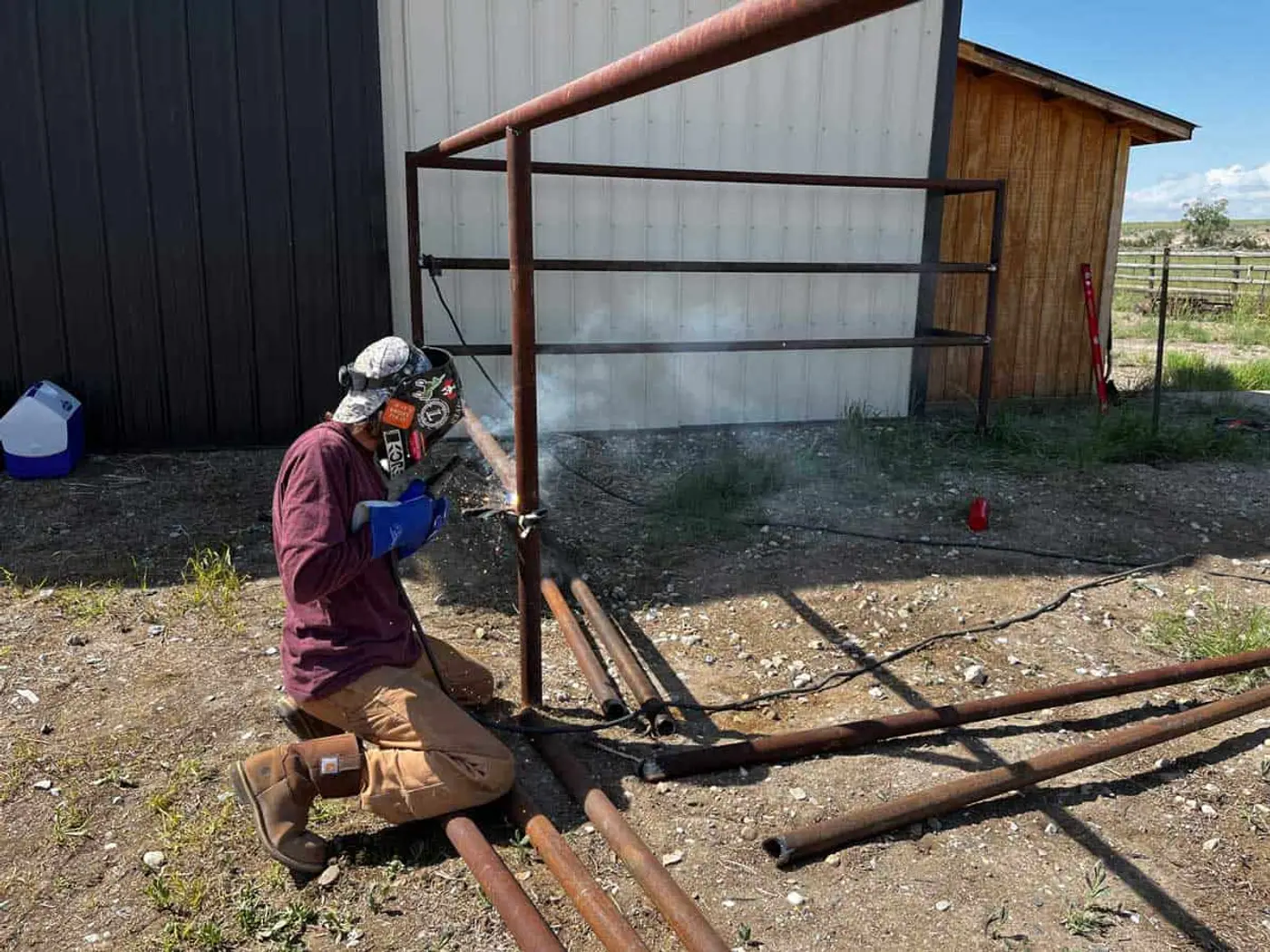
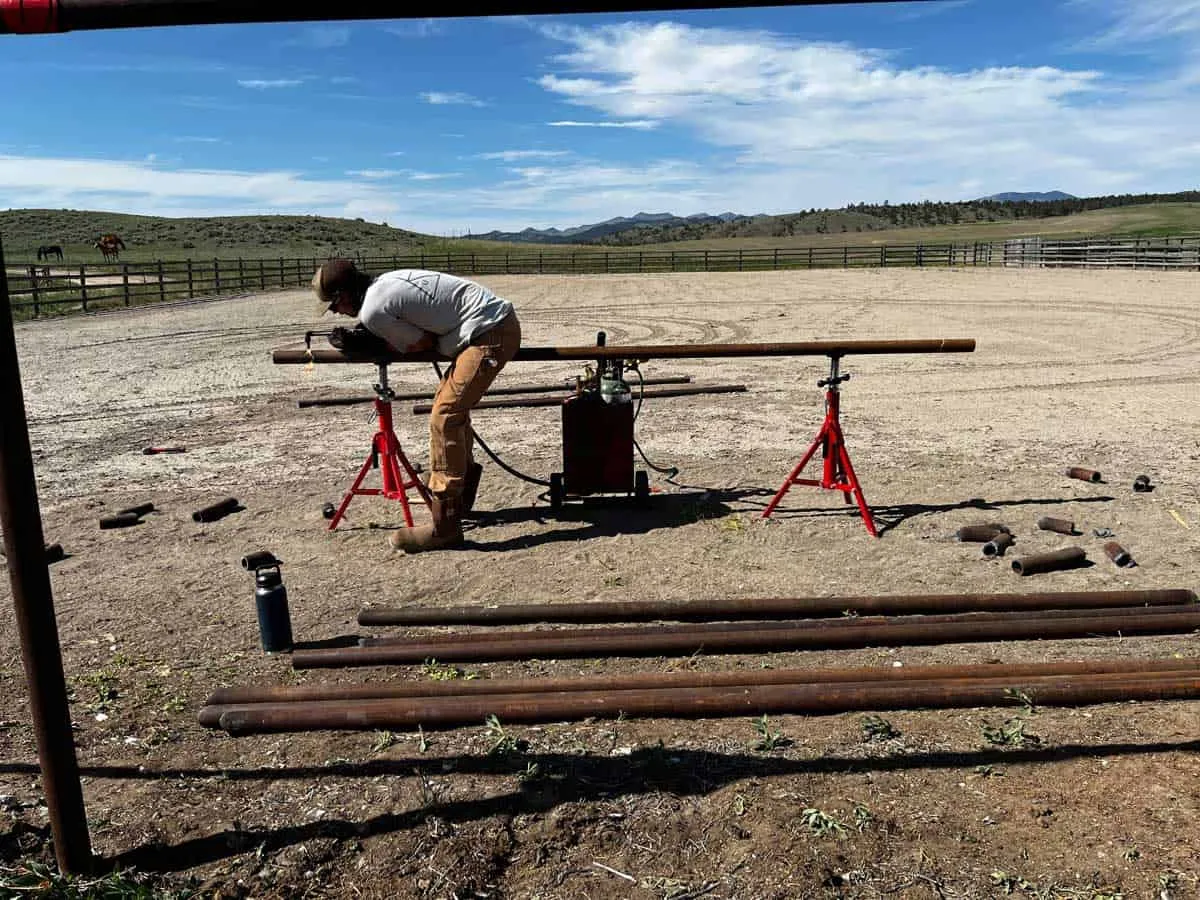 On-site repair work — most welding hours are fixes that beat replacement math.
Fabricate or buy? A quick decision frame
Buy stock when: the size is standard, the duty is light, and appearance doesn’t matter, a back-pasture wire gate needs no craftsman.
Fabricate when:
- The opening, grade, or geometry is nonstandard (most of them are, on old properties)
- The piece takes real abuse — livestock pressure, equipment contact, wind load
- It’s visible: entrances, railings, and anything near the house repay craftsmanship daily
- It must match something existing — an addition to a fabricated fence or a second gate to pair with the first
The hybrid move: stock panels and hardware, custom-fit frames and hinges. Plenty of our farm welding work is exactly this — catalog economics where they work, fabrication where they don’t.
What shapes a fabrication estimate
No invented prices — the honest drivers: steel weight and section, cut and weld complexity, finish (raw patina, paint, powder coat), mobilization for on-site work versus shop work, and design time for decorative elements. Simple duty gates and sculptural entrance pieces live on the same invoice ladder, far apart.
A worked example: the corral gate that didn’t exist
A composite of a job we see constantly, to make the fabricate-or-buy logic concrete. A working corral has an eleven-foot-six opening between set pipe posts — legacy of some long-forgotten decision. Stock gates come in ten and twelve. The owner’s options:
- Reset a post to fit a twelve-foot gate: concrete demo, new post, re-welding panel connections — a day of work to accommodate a catalog
- Hang a ten-footer with a filler panel: functional, ugly, and a snag point in a working corral where snag points cost calves
- Fabricate the gate to the opening: measured in the morning, built to dimension with the hinge and latch geometry matched to the existing posts, hung the same week
The custom gate isn’t the premium option there — it’s the cheapest correct option, once the alternatives are priced honestly. That’s the pattern with most ranch fabrication: the odd dimension is the normal case, and the catalog is the compromise.
Bring us the odd problem
- What’s broken, missing, or imaginary-but-needed?
- Exact opening or run dimensions, if it’s a fit job
- What hits it — animals, equipment, weather, nothing?
- Appearance: invisible, tidy, or showpiece?
- On-site or shop job?
Next step: Talk through a welding or fabrication project — or see ranch welding services and the gallery for the range, from corral fixes to entrance steel.