The most expensive fence mistakes happen before the first post goes in. A fence built for the wrong job — too light for the cattle, too low for the elk pressure, or routed across ground that turns to soup every April — costs as much as the right fence and does half the work.
Here are the questions worth answering before you request an estimate. You don’t need perfect answers to all nine; a builder can help fill the gaps during a property walk. But thinking them through first makes the conversation faster and the fence better.
1. What is the fence’s actual job?
Everything else follows from this. Montana fences generally do one or more of five things:
- Contain livestock: cattle, horses, sheep, goats each need different heights, spacing, and materials
- Keep animals out: deer and elk out of hay and gardens, dogs in the yard, predators away from small stock
- Mark a boundary: property lines, road frontage, subdivision edges
- Control access: driveways, equipment corridors, working areas
- Look right: entrance lines and road frontage where appearance carries real value
A pasture fence and an entrance fence on the same property are usually two different builds, and that’s normal. Our fencing comparison walks through which types suit which jobs.
2. What animals will test it?
Be specific — not just “cattle” but how many, how often they’re moved, and whether bulls share the line. Horses need highly visible fencing without footholds, which is why no-climb mesh is the standard for horse properties. Sheep and goats find gaps cattle never notice. And in most of Southwest Montana, deer and elk will test any fence around something they want to eat.
3. What is the ground actually like?
Walk the proposed line, ideally in spring when problems show themselves. Note:
- Rock: shallow ledge or river rock can make post setting impractical, which is where jackleg fencing earns its reputation
- Wet ground: spring seeps and low spots rot untreated posts and heave set posts over freeze-thaw cycles
- Steep grades: fences can climb steep ground, but the style matters and the labor changes
- Frost: post depth and footing decisions in this climate come down to frost behavior
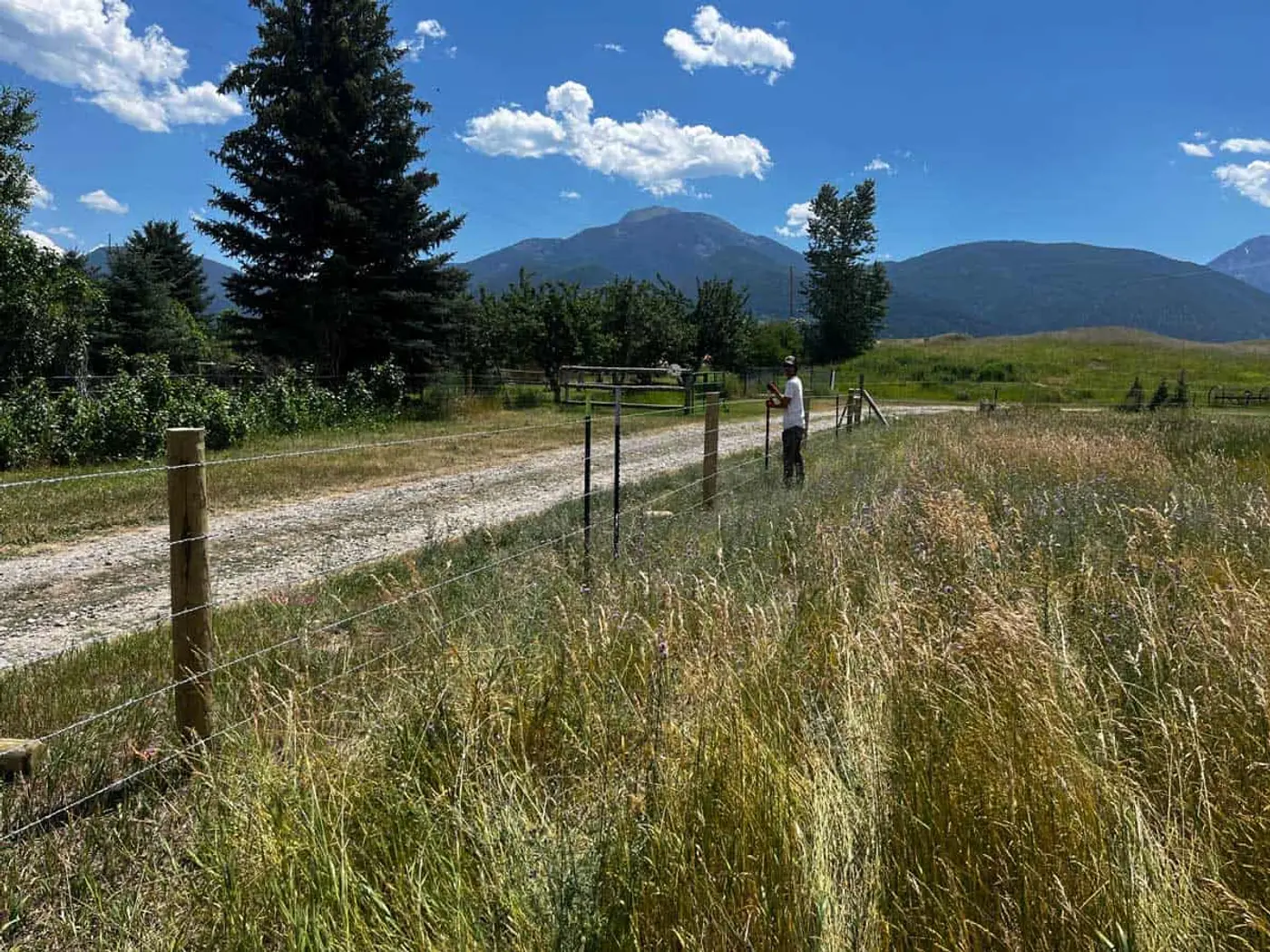
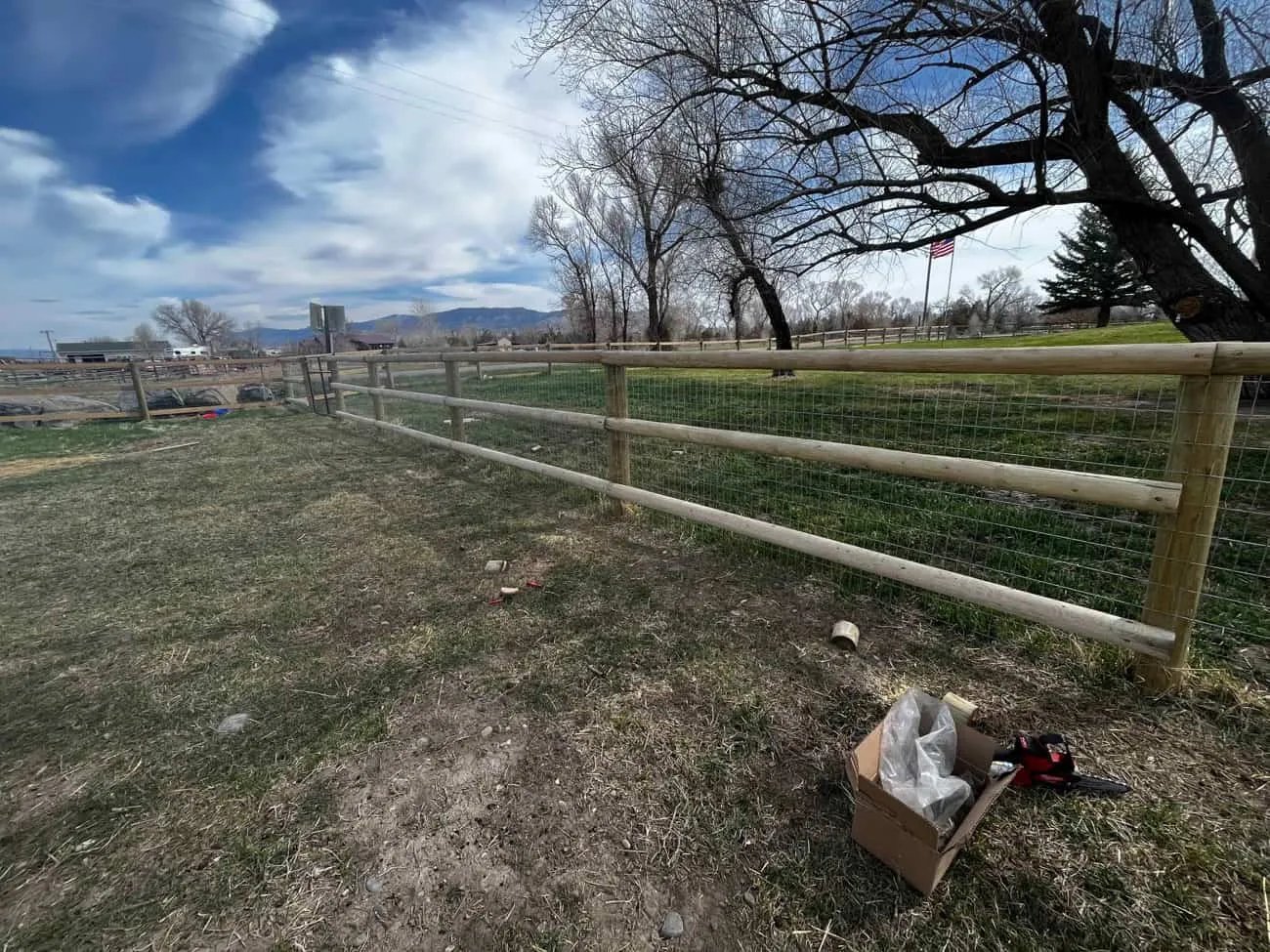 A fence line from the company gallery — gates and crossings decide how a fence works day to day.
4. Where do gates and equipment need to go?
Count every place a truck, tractor, baler, or stock trailer needs to cross the line — then add one. Undersized or missing gates are the most common regret we hear about fences built without a plan. Think about snow, too: a gate that opens into the drift line is a gate you’ll fight all winter. For high-traffic crossings on driveways, a cattle guard may beat a gate entirely.
5. Is there an old fence to remove?
Old wire and rotten posts don’t just disappear. Tearing out, stacking, and hauling an existing fence is real work that belongs in the project scope — one of our projects at Six Mile Creek involved removing decades of tired jackleg before the new line went in. If your fence line has an existing fence on it, plan for removal from the start.
6. What should it look like?
On working ground far from the house, function usually rules. Along the driveway and road frontage, appearance carries genuine property value. Plenty of Montana ranches run split rail or ranch board where people see the fence and field fence where they don’t.
7. When should it be built?
Frozen ground stops post pounding, but it doesn’t stop everything. Jackleg goes up nearly year-round because nothing penetrates the soil. If your timeline lands in winter, the fence style may decide itself — or the schedule may push to spring.
8. Who maintains it, and how?
Wood that needs stain, wire that needs tensioning, rails that need occasional replacement — every fence has a maintenance profile. Be honest about how much attention it will get. Steel continuous panel and pipe fencing cost more up front and ask almost nothing afterward.
9. What’s the budget conversation?
No fence estimate survives without footage, terrain, materials, gates, and access — which is why we don’t quote from the road. The variables that matter most are covered in our guide to what affects project cost, and free on-site measurements settle the rest.
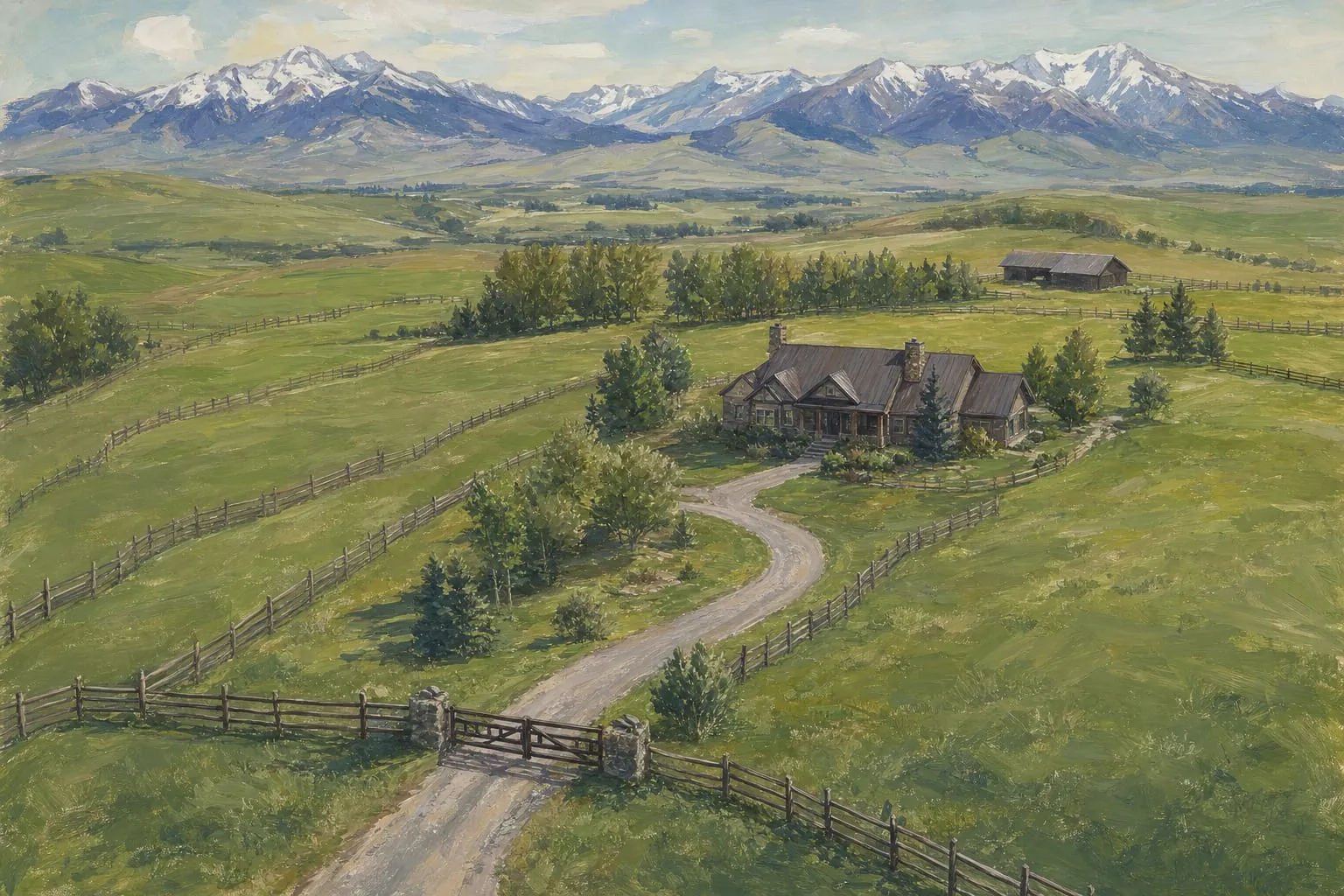 Conceptual planning illustration — thinking through fence jobs, gates, and terrain before construction.
Five planning mistakes we see most often
After enough fence projects, the same handful of regrets keep reappearing — all preventable at the planning stage:
- Too few gates, in the wrong places. The most common one by far. Walk the line imagining a tractor, a stock trailer, and a winter feed route — then add a gate you haven’t thought of a use for yet. Someone will.
- Fencing the survey line without walking it. Property lines cross bogs, rock ledges, and forty-percent grades with total indifference. Sometimes the right fence sits a few feet off the line on buildable ground (where your survey and neighbor agreements allow).
- Ignoring the old fence. Budgeting the new build but not the tear-out and haul-off leaves either a surprise cost or (worse) a derelict wire fence rotting beside the new one.
- Building for today’s animals only. The horse property that adds goats, the cattle place that adds a dog — fencing for the animals you’ll plausibly have costs little extra now and a full retrofit later.
- Treating winter as an off-season instead of a resource. Frozen ground stops post pounding but not jackleg construction — and winter crews often mean better scheduling than the June rush.
How much fence, roughly? Getting a number before anyone quotes
You don’t need survey precision to have a useful first conversation, but a rough footage figure changes the estimate from a guess into a plan. Three ways to get one, in rising order of accuracy:
Pace it or drive it. For a straightforward perimeter, walking the line with a measuring wheel or even counting truck-odometer tenths gives a number within a reasonable margin. A tenth of a mile is 528 feet, which is a handy unit once you start thinking in it.
Use the county’s parcel map. Most counties in this region (Gallatin and Park included) publish online GIS parcel viewers with a measuring tool. Trace your boundary on screen and it will total the distance. It won’t know about the creek or the rock outcrop, but it gets the perimeter close, and it’s free from your kitchen table.
Mark it in satellite view. Free mapping tools let you drop points along the intended line and read the total length. This is also the moment to spot things the ground hides: where the line dips into trees, where a neighbor’s fence already runs, where the driveway wants a gate.
A few practical notes that save money once you have a number:
- Corners and jogs cost more than straight run. A rectangle of a given perimeter is cheaper to build than the same footage full of angles, because every corner is a braced assembly. If the line can be simplified without giving up ground, it usually should be.
- Count gates separately. Gates are small projects inside the fence, so tallying them (and their widths) alongside the footage gives a truer picture than linear feet alone.
- Note the sections you already know are trouble. Rock, wet spots, and steep pitches change the build. Flagging them on your rough map is more useful than a precise total, because those are the places a fence type gets decided.
Bring that rough number and a marked-up map to the site walk. It focuses the whole visit: instead of establishing what exists, we spend the time on what to build. And if your figure turns out to be off once it’s measured properly, that is genuinely fine. Rough beats absent, and the free measurement settles it either way.
Put it on paper, then walk it
A rough sketch of the property with proposed lines, gates, and problem spots is worth an hour of anyone’s time. It doesn’t need to be pretty. When you’re ready, we’ll walk the line with you, measure it properly, and give you honest numbers and material options.
Next step: Plan your fence project (free estimates and measurements across Southwest Montana) or browse completed fence projects to see what these decisions look like on real ground.