Roads don’t wear out. They get washed out, slowly, in installments, by water doing quiet work between the moments anyone looks. Traffic gets blamed because traffic is visible, but on rural roads the destructive partner is almost always drainage. Which is good news, in a way: water leaves warnings long before it takes the road. You just have to know what you’re reading.
Here are the six signs worth a walk down your road this month, winter and early spring are when they show best.
1. Fine lines running downhill: rills
Little finger-width channels in the road surface, running with the grade. Rills are water’s first draft, proof that runoff is traveling along your road instead of leaving it. Left alone, this season’s rills merge into next season’s gully. Rills mean the crown is gone: the surface no longer sheds water sideways, so water runs the length of the road picking up speed and material as it goes.
The fix that holds: re-establishing crown when the road is graded, not just smoothing the surface flat, which quietly recreates the problem with a tidier appearance.
2. Puddles that outlive the storm
Standing water a day after weather is a soft-spot instruction manual: each puddle marks where the surface has settled, where fines have pumped up, and where the next pothole is scheduled. Water sitting on a road is soaking into the road, and in a Montana winter, saturated base becomes ice lenses, and ice lenses become the spring-thaw failures that swallow tires in April.
3. Culverts doing nothing
A culvert only works if water can reach it, pass through it, and leave it. Walk your culverts and check all three:
- Inlets buried in silt, sod, or beaver ambition
- Barrels crushed, rusted through, or frozen solid in early winter (a culvert that froze full in November floods across the road during the first February chinook)
- Outlets eroding a plunge pit that eats back toward the road — the quiet start of a washout
A culvert cleaned annually costs minutes. A culvert replaced after a washout involves excavation, imported material, and a stretch of rebuilt road.
4. Edges going soft and round
Healthy gravel road edges have a defined shoulder that carries water into the ditch. When edges slump, round over, or grow a grass lip that traps water on the surface, the road is losing its escape routes. A grass berm along the edge (natural as it looks) turns the whole road into a bathtub.
5. The ditch that ends nowhere
Ditches fail two ways: they fill up (silt, sloughing, vegetation), or they never had anywhere to go in the first place. Follow your ditch on foot — the whole run. If it dead-ends into a field, a fence corner, or simply fades out, the water is exiting wherever it pleases, and its favorite exit is usually across (or through) your road base.
6. New paths appearing after big weather
Every major melt or storm redraws the map slightly. New channels across the road, sediment fans in the barrow pit, gravel deposited somewhere it wasn’t — each is a receipt for water that traveled somewhere unplanned. One event is information. The same event twice is a design problem asking for a drainage-first repair.
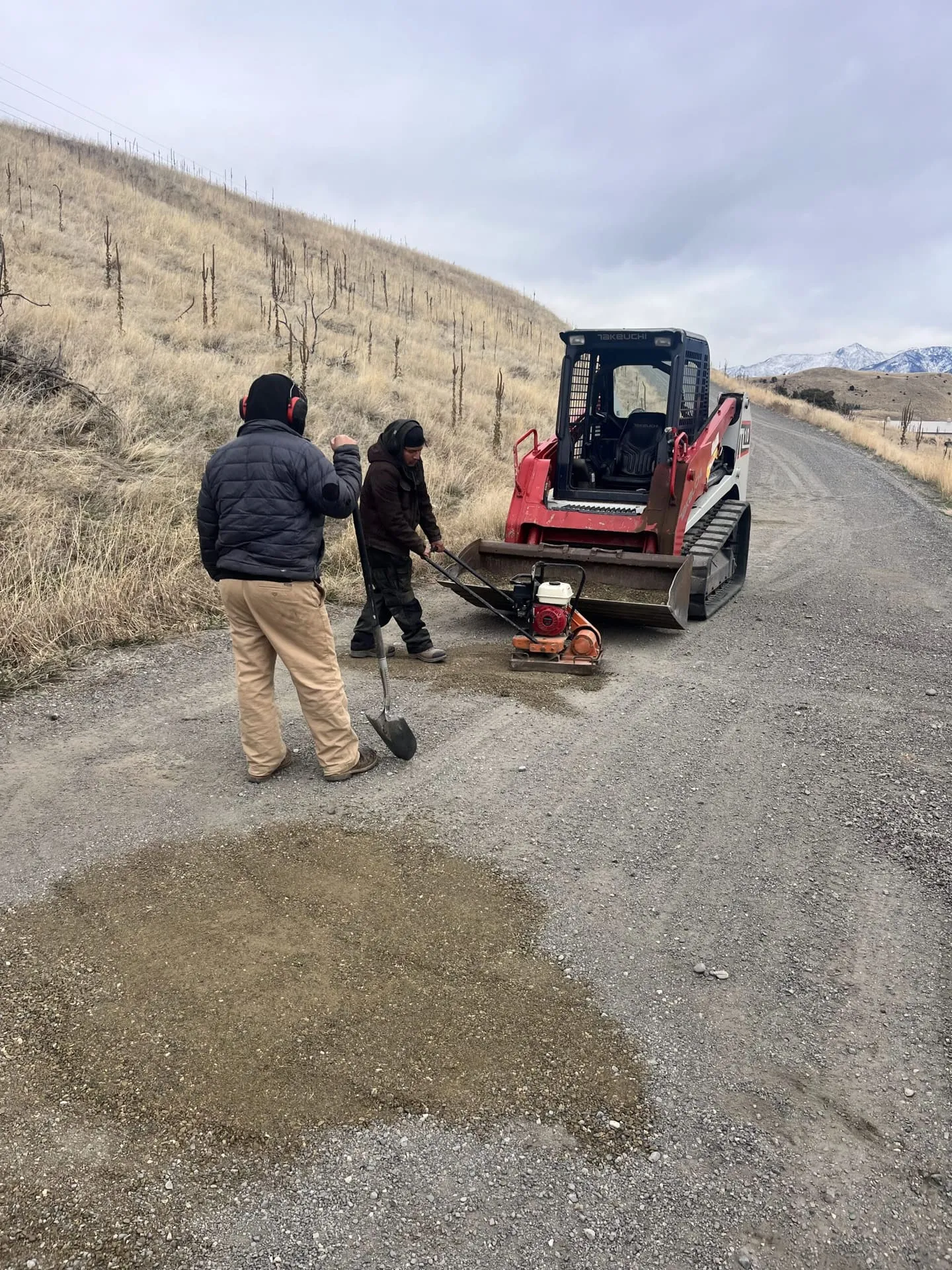 Repairing a soft, water-worn spot, the kind of failure drainage problems create if water is left to sit.
What holding the line actually looks like
The maintenance rhythm that keeps water losing, ranked by value:
- Crown and grade maintained while damage is cosmetic
- Culverts and ditches walked and cleared twice a year — before freeze-up, after melt
- Soft spots dug out and rebuilt rather than re-topped; surface gravel dumped into a base failure is rent, not repair
- Water crossings dignified: proper culverts or rolling dips where water insists on crossing, because insisting harder than water is a losing bet
When the warnings have been accumulating for years, the real question shifts from maintenance to repair versus reconstruction — the subject of our companion piece.
The twice-a-year road walk, condensed
Print-this-list version — fifteen minutes in April and October:
- Walk the full ditch line: flowing, filled, or fading out?
- Check every culvert: inlet clear, barrel open, outlet not eating backward
- Scan the surface after rain: rills, ponds, or clean shedding?
- Probe last year’s soft spots with a heel: firm or faking it?
- Look at the edges: defined shoulder or grass lip trapping water?
- Note anything new since the last walk — new is never good news on a road
- Photograph problems with something for scale; the pictures build the repair scope
Two walks a year, done with your eyes open, catch nearly everything while it’s still a maintenance item instead of a reconstruction line.
Where to go from here: Discuss your road’s drainage — an on-site evaluation reads the water story quickly, and winter/early-spring damage tells the truth better than any other season. Recent road and drainage work is in the gallery.