A new road is the most permanent decision most property owners ever make. Fences get rebuilt, structures get replaced — but the road, once cut, defines how the property works for generations. The route you choose this year is the route someone plows, grades, and drives in 2060.
That permanence is good news if the road is planned like infrastructure and expensive news if it’s planned like a line on a napkin. Here’s what goes into the difference.
Route: the decision that outranks all others
The shortest line between the county road and the building site is almost never the best road. What to weigh instead:
Follow the ground where you can. Roads that work with contours need less cut-and-fill, drain naturally, and cost less to build and forever less to maintain. Fighting terrain is sometimes necessary; doing it casually is just donating money to erosion.
Cross water deliberately. Every drainage crossing (seasonal draw, irrigation ditch, live creek) is a designed structure (culvert, low-water crossing, or bridge-class decision) and possibly a permitting conversation. Fewer, better crossings beat many casual ones.
Respect the wet spots. That green meadow strip is green for a reason. Spring seeps and high water tables that are invisible in August will own your road in April. Route around them or budget for the engineered section that crosses them — deciding after the road fails is the expensive third option.
Think about winter on day one. North-slope cuts hold ice, wind-exposed benches drift shut, and steep pitches that are fine in July are toboggan runs in January. The plow’s path (and where plowed snow goes) is part of the route design. (Our snow planning guide is effectively a route-review checklist.)
Grades matter for what you’ll haul. A grade a pickup ignores is a different question for a loaded stock trailer or a concrete truck. If equipment will use the road, its limits set the ceiling.
Drainage: the actual product you’re buying
A gravel road is a drainage system that happens to carry vehicles. The construction elements:
- Crown so water leaves the surface immediately
- Ditches along the uphill side with somewhere real to go
- Culverts at every place water wants to cross — sized for spring melt, set at correct depth and slope
- Outsloping or rolling dips on steeper sections, so water exits the road frequently in small volumes rather than rarely in destructive ones
Skimping here isn’t saving; it’s prepaying for erosion repair.
The base: where road budgets are honestly spent
What separates a built road from spread gravel is everything you can’t see:
- Stripped organics: topsoil under a road becomes a sponge; it comes off first
- Prepared, compacted subgrade: the native ground shaped and consolidated
- Geotextile where soils demand it: keeping base rock from disappearing into soft subgrade over the years
- Structural base rock: the load-bearing layer, compacted in lifts
- Surface gravel: the wear layer with binding fines, the only part anyone sees
Roads that fail every spring are almost always missing layers two through four. That’s also why quoting a road sight-unseen is malpractice: identical lengths over different ground are entirely different projects. Soil, water, rock availability, and haul distance drive everything — an on-site evaluation with our road construction crew settles the real scope.
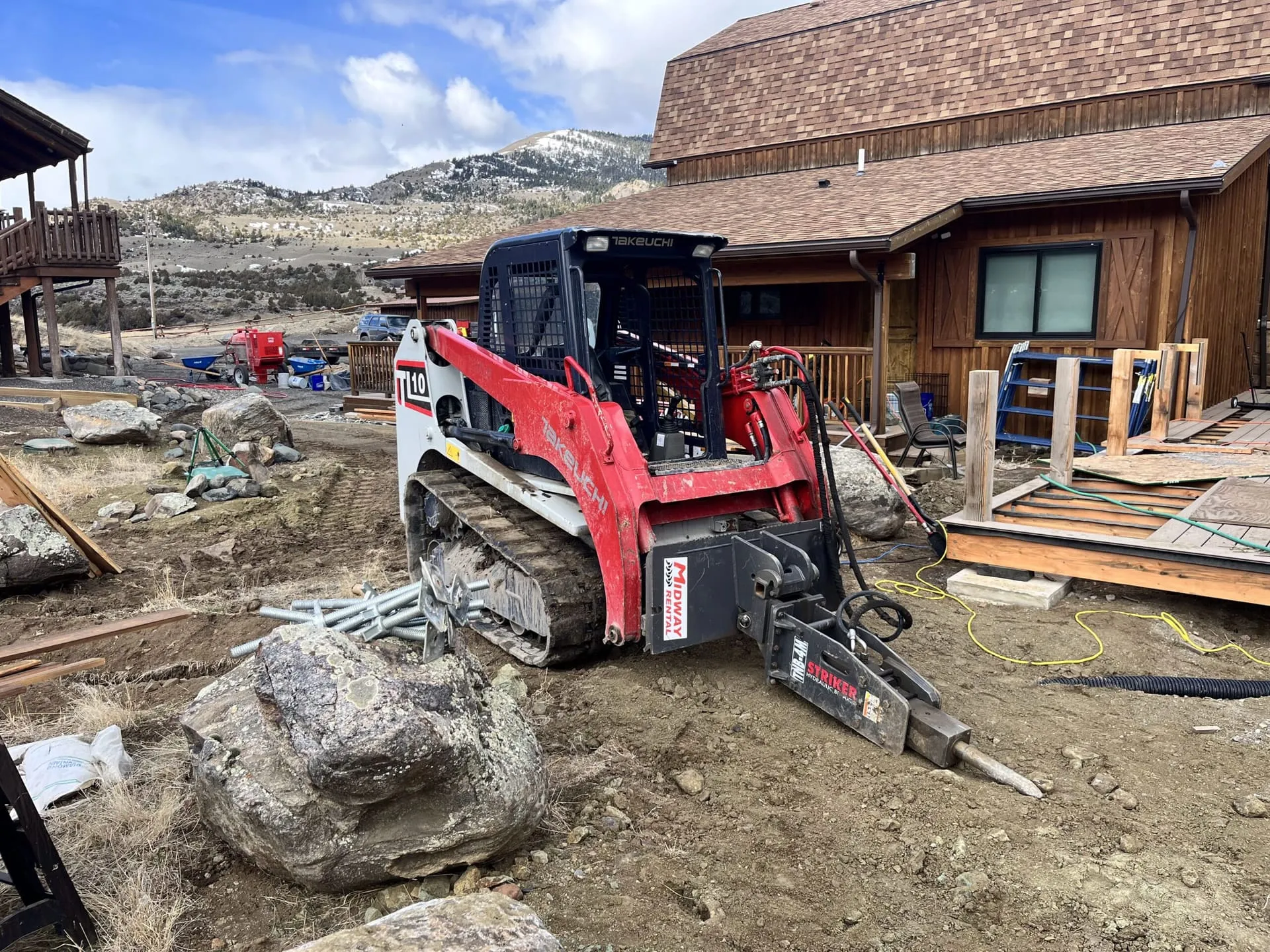 Equipment and earthwork from the gallery — the base layers are the road you never see.
Sequencing with the rest of the property
New roads rarely travel alone. Plan them alongside:
- Utility trenching: power and water often share or parallel the corridor; trench before surfacing, never after
- Site excavation: building pads and the road want a coordinated cut/fill plan so material moves once
- Entrances: the junction with the county road is both a safety design and, often, the future home of the gate or archway; rough-in accordingly
- Cattle guards where the road crosses stock boundaries
Five new-road mistakes that cost for decades
- Routing by the shortest line. The direct route over the wet swale saves five hundred feet of road and buys thirty years of maintenance. Distance is cheap; bad ground is expensive forever.
- Building the surface before the utilities. Trenching across a finished road for the power line someone forgot is the classic rural sequencing failure — sleeves and crossings go in before gravel.
- One culvert short. Water that crosses in April but not August gets missed in summer planning; the road tells you where the missing culvert was by washing out there. Route the walk in spring or trust spring evidence.
- Grade over the plow’s head. Pitches that a summer pickup climbs happily can be unplowable (or unstoppable) in January. If the road serves winter, winter sets the grade limits.
- Skipping compaction to save a day. Base placed without lift-by-lift compaction settles under traffic into the ruts and hollows it was supposed to prevent — invisible on delivery day, permanent by year two.
Easements, crossings, and who to call before you cut
This is the part road projects skip and then regret. Before a blade touches ground, a few questions are worth answering, and most of them are phone calls rather than construction. None of what follows is legal advice, and requirements genuinely vary by county, jurisdiction, and site, so treat this as a checklist of who to ask rather than a list of rules.
Where does the road actually cross onto the county road? An approach onto a public road is often its own permitted item, with the county or state having a say in location, sight distance, and how the approach is built. The right first call is your county road department or the Montana Department of Transportation for the local district. Better to learn the requirements before you’ve graded to a spot they won’t approve.
Does the route cross water? Culverts on a live stream, work in a stream channel, or crossings in wetland areas can trigger review by agencies that look after waterways. The relevant offices, such as the conservation district or the appropriate state and federal agencies, can tell you quickly whether your crossing is routine or needs a permit. A seasonal draw and a live creek are very different conversations.
Whose ground does the road actually use? If any part of the route relies on an easement across a neighbor, or if a shared private road is involved, the access rights want to be clear and in writing before construction, not discovered afterward. This is a conversation for the parties and, where needed, a title or legal professional.
Are there buried utilities on the line? Utility locates come before digging, every time. Public locate services mark utility-owned lines, but private lines, the power to the well or the old irrigation main, are yours to flag from memory and old records.
The reason to front-load all of this is simple: a road is permanent and expensive, and the cheapest version of a permit problem is the one you solve with a phone call before the work, not the one you discover with a stop-work conversation during it. A good contractor will know which of these apply to your specific project and will expect to work through them with you as part of planning the route.
Questions to answer before an estimate
- What’s the heaviest, longest vehicle that will ever use it?
- Where does water cross the proposed line — in April, not August?
- Any sections you already suspect are soft or springy?
- Winter use: daily, occasional, or seasonal?
- Utilities now or someday?
- Is there gravel source on-site, or is everything hauled?
Walk it with us: Discuss your road project — we build, grade, and rebuild private roads across Southwest Montana, and the site walk is where a good road actually begins. Recent road and equipment work is in the gallery.