Somewhere around the third spring of grading the same failures out of the same road, most owners start asking the right question: are we maintaining this road, or performing annual funerals for it? It’s the correct instinct. Roads have three levels of intervention, and money spent at the wrong level doesn’t accumulate, it evaporates.
Here’s the framework for telling which level your road actually needs.
The three levels, plainly defined
Level 1, Maintenance: grading and gravel. Reshaping the existing surface, restoring crown, adding wear gravel. Right when the road’s bones are sound: base intact, drainage functioning, damage limited to the surface layer. This is cheap, fast, and the correct answer for most roads most years.
Level 2, Targeted repair. Excavating and rebuilding specific failed sections, digging out a soft spot to solid material and rebuilding the base, replacing a culvert, re-establishing a ditch line, while leaving the sound majority alone. Most “bad roads” are actually fine roads with three or four genuinely failed zones.
Level 3, Reconstruction. Treating the road as a new build on an existing alignment: stripping, re-establishing subgrade, base material in compacted lifts, drainage designed rather than inherited. Reserved for roads that were never built right (spread gravel on dirt) or whose base has broadly failed.
The diagnostic: what your road is telling you
Signs Level 1 is enough:
- Washboard, dust, minor potholes that grade out and stay out for a season
- Crown worn flat but base firm underfoot even in spring
- Damage roughly uniform along the road, not concentrated
Signs you’re in Level 2 territory:
- The same spots fail every year while the rest holds, recurring soft zones are base failures wearing a surface costume
- Drainage warnings at specific stations: a dead culvert, an edge washout, one section that ponds
- Frost boils in defined areas each spring, localized saturation, localized fix
Signs the conversation is Level 3:
- Grading buys weeks, not seasons
- Soft in random, migrating locations, the signature of no real base anywhere
- Mud pumping up through fresh gravel within a year (fines rising through the profile because there’s no separation layer)
- The road predates any known construction, it’s where wagons drove, then trucks, then gravel got spread on the ruts
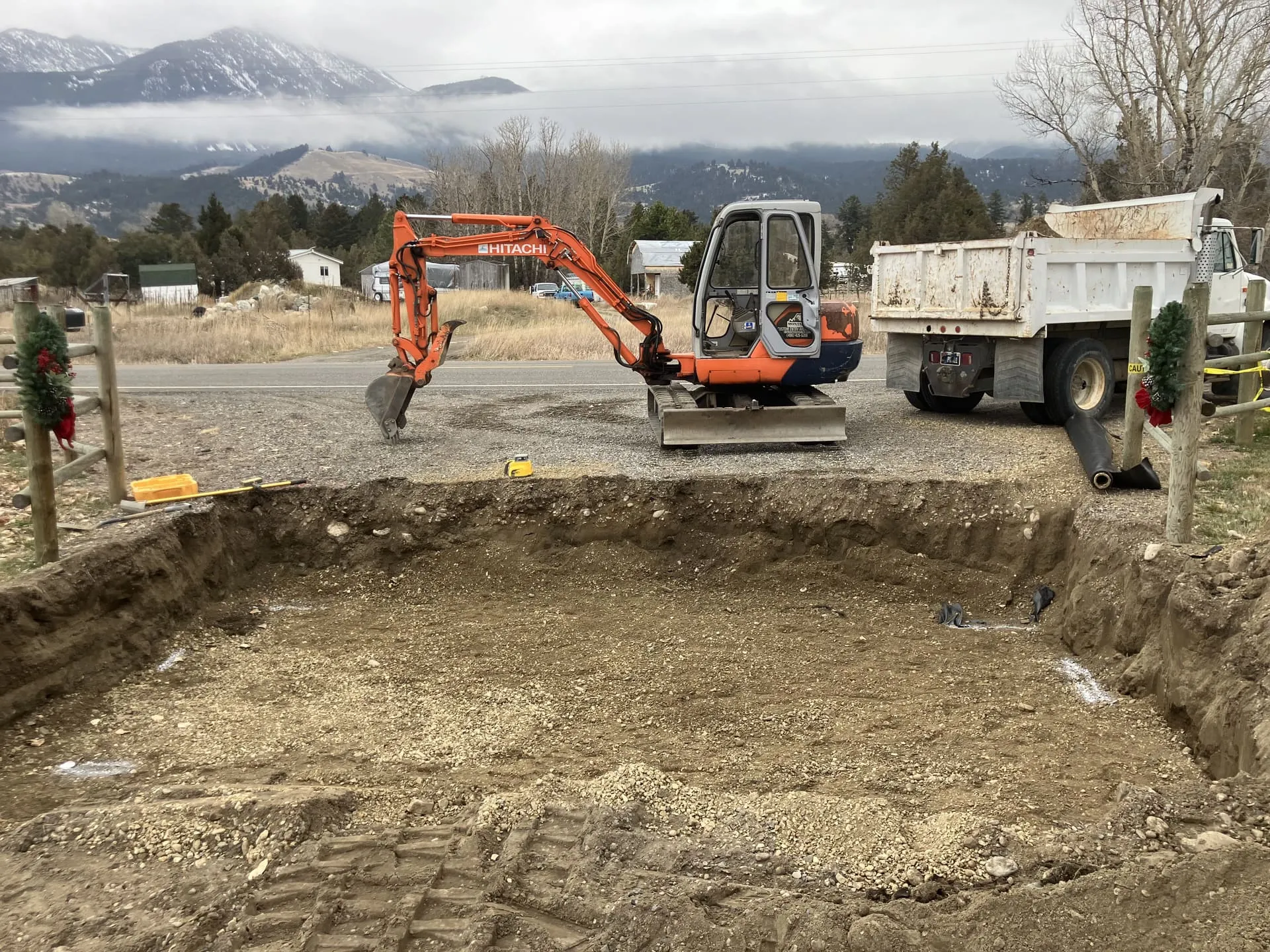 Level 2 in action: digging out a failed section to solid material before rebuilding the base.
Why the wrong level is expensive in both directions
Under-treating is the familiar failure: gravel spread over a failed base disappears into it, a wet spring pulls new rock down into old mud, and the invoice repeats annually with nothing accruing. Surface gravel on a base failure is rent.
Over-treating is real too: reconstructing a road whose problems were two culverts and a lost crown is money that drainage work and a grader would have solved. This is why the diagnosis (walking the road, probing the soft spots, reading the water) matters more than the prescription. Our road repair crew does exactly this evaluation, and the recommendation is frequently smaller than the owner feared.
The hybrid reality of most projects
Real roads rarely sort neatly into one level. The typical Southwest Montana outcome:
- 70–80% of the road: grade, crown, gravel — Level 1
- A handful of stations: dig-out and base rebuild, a culvert or two — Level 2
- One ugly stretch (the low crossing, the springline section): rebuilt properly — Level 3, locally
That mix (fixing each section at its level) is how a limited budget buys a road that behaves like new without paying for reconstruction it didn’t need.
Timing notes for this climate
- Late winter/early spring is diagnosis season: failures announce themselves plainly during breakup
- Summer and early fall are construction season: base work wants dry material and good compaction weather
- Booking the evaluation in spring for summer work is the schedule that serves owners best — and it means one season, not two, from decision to done
The questions owners ask at this decision point
Can we just do the worst section this year? Usually yes — and it’s often the right call. Roads repair well in phases if the phasing follows the diagnosis: fix the failed base sections first, because gravel spent on top of them is lost, then surface the sound majority afterward.
Will new gravel alone buy a few years? On a sound base, absolutely — that’s normal maintenance. On a failed base, it buys months. The heel-probe test in spring tells you which situation you own before you order trucks.
How do we know the base failed and not just the surface? Depth of the symptoms: surface problems grade out and stay out; base problems return in the same footprint, pump fines upward, and feel soft underfoot in spring even when the surface looks dressed.
Is there a season where reconstruction is cheaper? Reconstruction wants dry — mid-summer through early fall. Booking after a spring diagnosis gets the good calendar; deciding in September risks racing the freeze with compaction quality on the line.
Questions we’ll work through on-site
- Which failures repeat, and where exactly?
- What does the road carry — daily pickups, stock trailers, delivery trucks?
- What’s under the surface — any memory of how the road was originally built?
- Where does the water go now, and where should it go?
- Budget shape: one season, or phased over two?
Next step: Discuss your road project — we’ll walk it, probe it, and give you the straight level-by-level breakdown. Road work from around Paradise Valley is in the gallery.