Most people choose deck boards the way they choose paint: by looking at samples. It’s an understandable instinct and a slightly misleading one, because the sample in your hand is showing you day one. What matters on a Montana deck is year eight, after eight summers of high-altitude sun and eight winters with snow sitting on it for months.
Here’s how the three common choices actually behave here, and the part of the decision most people miss entirely.
First, the uncomfortable truth about deck boards
The boards are the part you see and the part you shop for. They are not the part that decides whether your deck is still solid in fifteen years.
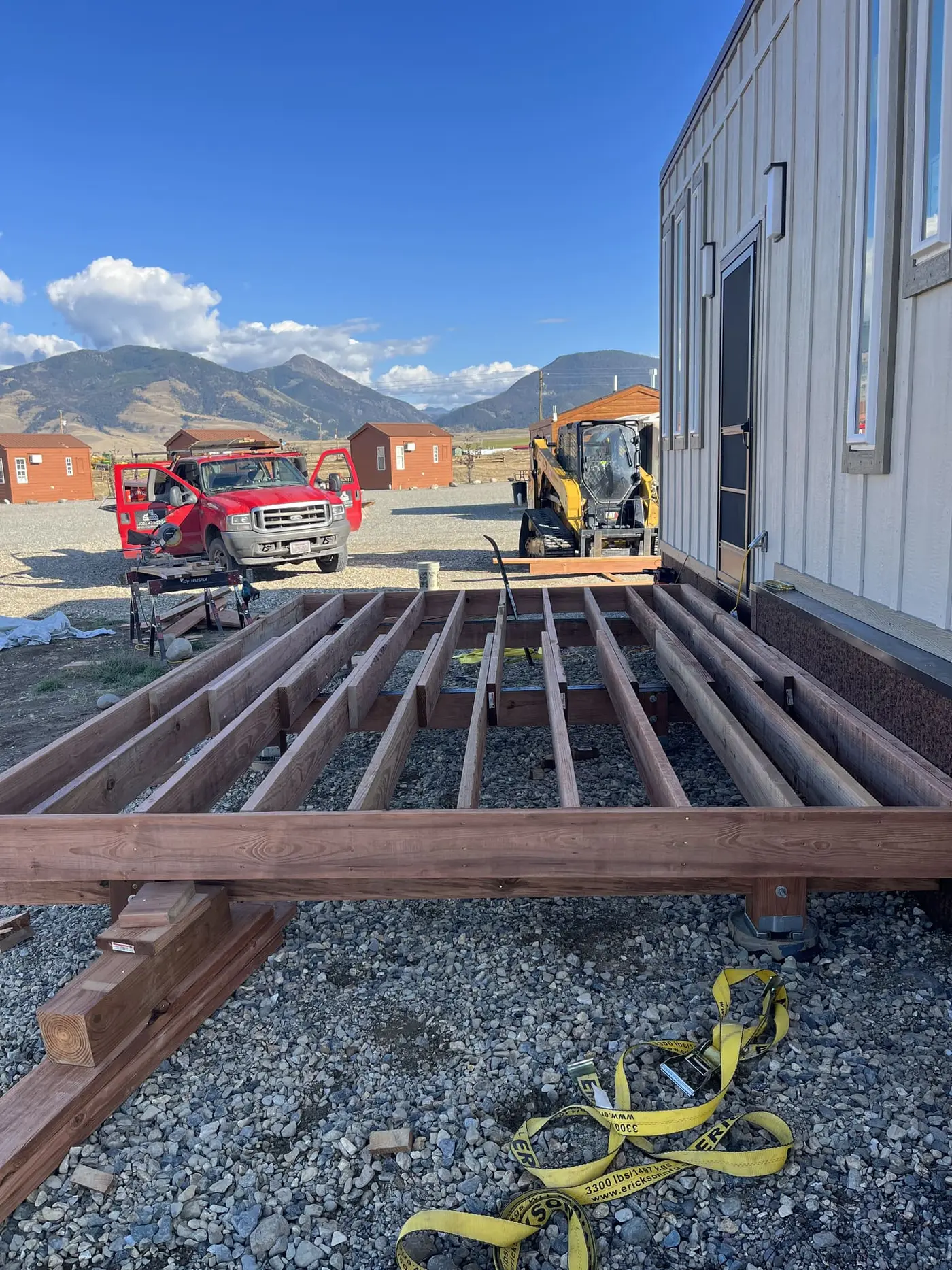
That’s the framing, the footings, the fasteners, and the drainage. A cedar deck on properly sized joists with footings below frost depth will outlast a composite deck built on shallow piers every single time. We’ve torn out decks with perfect-looking surfaces sitting on framing that had quietly rotted or heaved underneath.
So choose your boards for how you want the deck to look and how much maintenance you’re willing to do. Just don’t let the board conversation crowd out the structural one, and be suspicious of any bid where the surface material is discussed in more detail than what’s holding it up. Frost depth is the number that matters more than any brand name.
With that said, the surface does matter. Here’s the real comparison.
Composite and PVC
Composite boards blend wood fiber with plastic; PVC boards skip the wood entirely. Both are sold on the same promise: no staining, no sealing, no annual weekend of maintenance.
That promise is largely true, and it’s why composite has taken over so much of the market. What the brochures cover less well is how these products behave in a climate with our temperature range.
Thermal movement is real. Plastic expands and contracts with temperature more than wood does, and a place that swings from below zero in January to ninety-plus in July asks a lot of that. This is why manufacturers publish specific gapping requirements for end-to-end and side-to-side spacing, and why those requirements change depending on the temperature at installation. Boards installed on a cold spring day need different gaps than the same boards installed in August. Ignoring that is one of the most common ways a composite deck ends up buckling or leaving ugly gaps.
Dark colors get genuinely hot. A dark composite deck in full afternoon sun at elevation can be uncomfortable barefoot. If your deck faces south or west with no shade, that’s worth weighing against the color you like on the sample.
Snow removal takes a little care. A metal shovel scraped across composite will scratch it. A plastic shovel and a slightly gentler approach solve it, but if your deck is a path you clear all winter, that’s a habit to build.
Scratches don’t weather away. Wood dents and then greys into its dents. Composite tends to show a scratch as a bright line that stays a bright line. It’s durable, but it isn’t self-healing the way wood sort of is.
Composite is the right answer for a lot of people, especially anyone who genuinely will not re-finish a deck and knows it about themselves. Just buy it with realistic expectations rather than the “zero maintenance forever” version.
Cedar
Cedar is the traditional choice here and it earns its place. It’s naturally resistant to rot and insects without chemical treatment, it’s light to work with, it stays cooler underfoot than dark composite, and it looks like it belongs on a Montana property in a way that manufactured board sometimes doesn’t.
Its two honest downsides are softness and upkeep.
Cedar is soft. Dragged furniture, dog claws, and a dropped tool all leave a mark. Some people read that as damage and some read it as patina, and it’s worth knowing which kind of person you are before you commit.
Left alone, it silvers. Unfinished cedar weathers to a soft grey. If that’s the look you want, wonderful — the maintenance conversation mostly disappears. If you want it to stay warm and reddish, that means re-finishing on a cycle, and our combination of intense UV and very dry air is hard on finishes. This is not a one-and-done product.
The mistake is buying cedar for the color in the showroom and then never touching it again. You’ll get grey, and you’ll be disappointed by something that was entirely predictable.
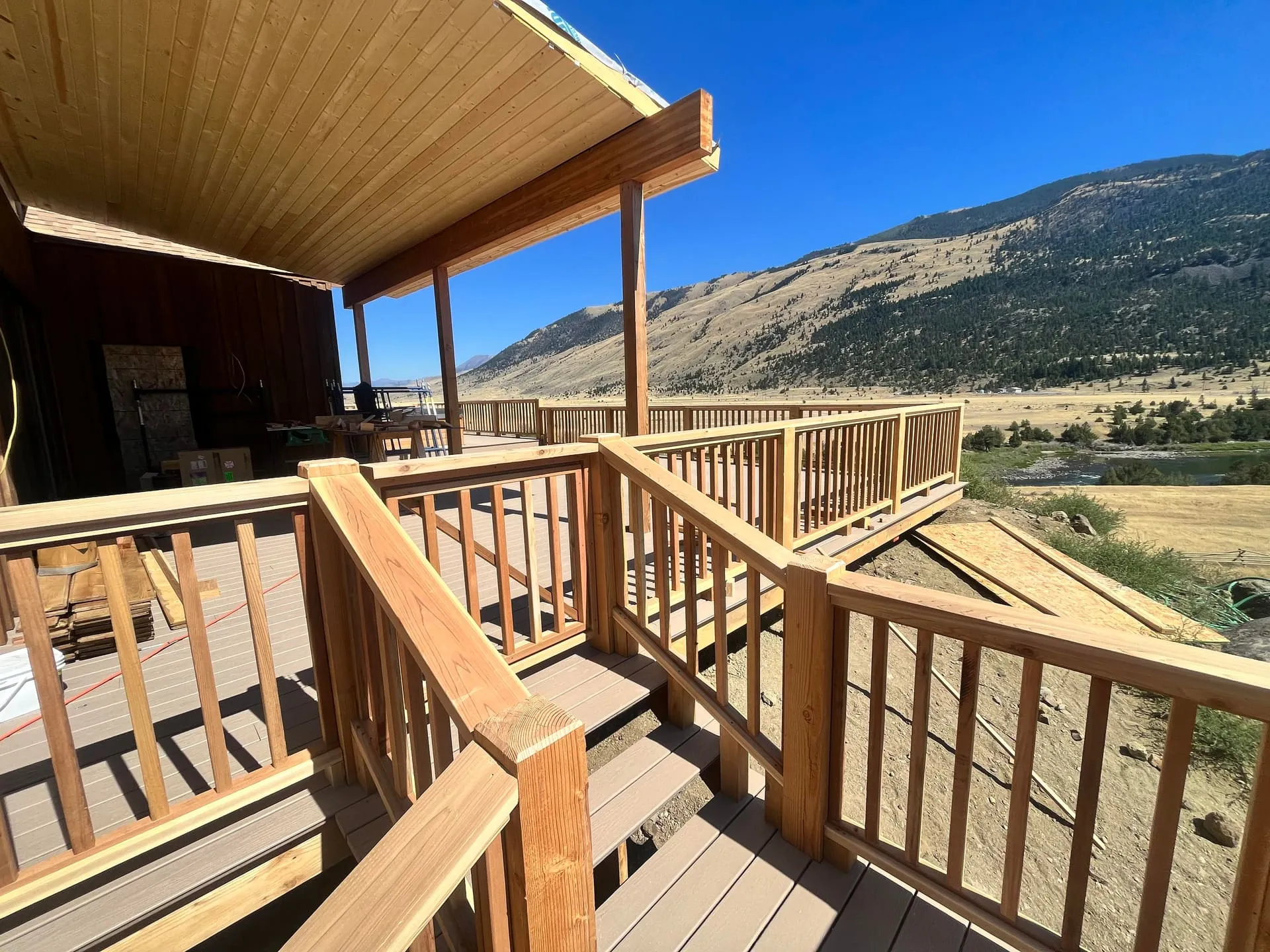 The railing and the framing decide as much about a deck as the boards do.
Tropical hardwoods
Ipe and similar dense hardwoods are the premium end. They’re extraordinarily hard, extremely durable, and they have a depth of grain that no manufactured product quite reproduces.
They also come with real trade-offs that show up as cost.
They’re brutally dense. Hardwood decking generally requires pre-drilling for every fastener, or hidden fastening systems that mill into the board edge. It dulls blades and bits fast. All of that is labor, and labor is why the installed price runs well above the material price difference alone.
They’re heavy. Dense hardwood weighs substantially more than cedar. On a large or elevated deck, that weight is part of the structural conversation, not an afterthought.
They silver too. Left unfinished, hardwood weathers grey like anything else. Keeping the deep brown means oiling on a cycle, and in our climate that’s a real commitment on a large deck.
Hardwood is the right choice when someone wants a surface that will outlast almost anything, is prepared for the cost, and genuinely appreciates the material. It’s the wrong choice when someone wants “the best” without wanting the maintenance that keeps it looking like the reason they bought it.
Pressure-treated
Worth mentioning because it’s the budget default. Treated lumber resists rot and insects effectively and costs the least by a wide margin. It also tends to move, check, and twist more than the alternatives as it dries, especially in dry air.
It has a legitimate place, particularly for structure, for utility decks, and for projects where budget is the binding constraint. It’s just rarely what someone means when they say they want a nice deck.
How the decision usually shakes out
Strip away the brand marketing and it comes down to four questions:
How much maintenance will you actually do? Not intend to do. Actually do. Be honest, because this single answer eliminates one or two options immediately.
Do you want it to stay a color, or are you fine with grey? If grey is fine, wood gets dramatically easier. If it isn’t, you’re either on a finishing schedule or you’re buying composite.
Where does the sun hit, and where does the snow sit? A south-facing deck with no shade changes the color conversation. A deck you shovel all winter changes the surface conversation.
What’s the deck attached to? A refined home with substantial stone and timber can carry hardwood or a high-end composite. A working ranch house often looks best in cedar. A deck should read as part of the building, not as a product catalog decision.
The part worth spending on
If your budget is fixed and you have to choose, put money into the structure and the details rather than upgrading the board.
Footings below frost. Framing sized for the span and, at elevation, for the snow that will sit on it. Proper flashing where the deck meets the house, which is where a shocking number of deck problems and rot actually start. Fasteners rated for the environment. Enough ventilation underneath that the framing dries out instead of staying damp.
Those choices are invisible in photographs and they’re what determine whether you’re enjoying the deck in twenty years or rebuilding it in ten. A cedar deck built right is a far better outcome than a hardwood deck built on shortcuts.
Where we land
There’s no universally correct board. There’s the one that fits your property, your tolerance for upkeep, and the way your deck will actually be used and cleared.
When we design a deck, we work through those questions before anyone looks at a sample, because the answers usually narrow it to one or two options on their own. And because we handle the framing, the stone, and the site work around it, the deck gets planned as part of the whole outdoor space rather than as a surface bolted to the back of the house.
When you’re ready: plan your deck project and we’ll walk the site, look at the sun and the snow, and give you an honest read on what will still look good in a decade. Free measurements across Gallatin and Park counties.