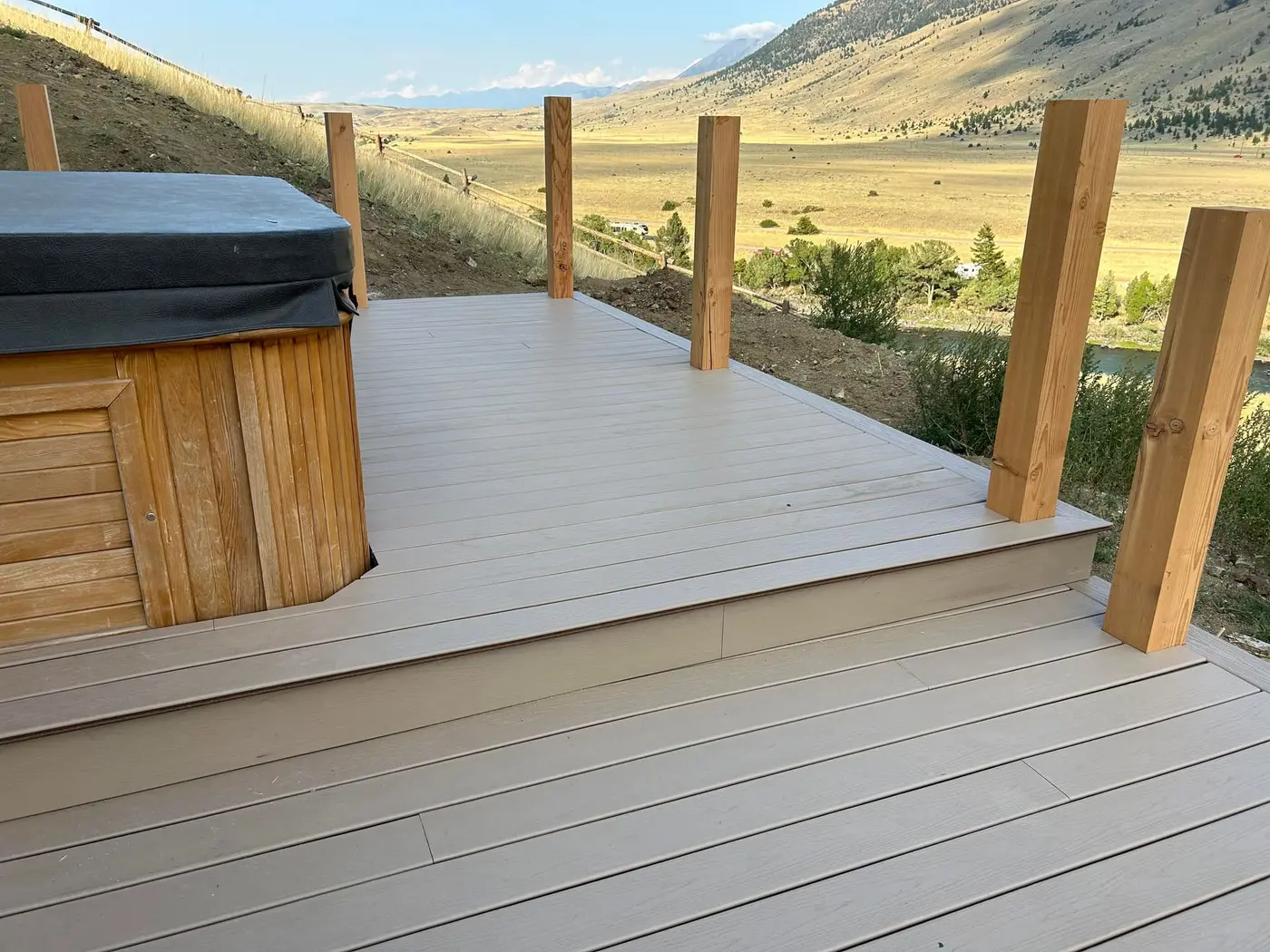
A deck in the Gallatin Valley and a deck up toward Big Sky can look like the same project. Same footprint, same boards, same railing, similar view out the back. Underneath, they are not remotely the same structure, and the difference is snow.
This is the single most misunderstood thing about building at elevation, and it’s the reason a deck priced from a photograph is a deck priced wrong.
What “snow load” actually means
Snow load is the weight snow puts on a structure per unit of area. The important thing to understand is that it isn’t primarily about depth.
Snow density varies enormously. Fresh, dry powder is very light. That same snow, after it settles, gets rained on, partially melts and refreezes, and has more snow packed on top of it, becomes dramatically heavier. A deck can carry the same depth of snow at two different times of year and be under substantially different load.
The worst case usually isn’t the biggest storm. It’s late in the season, when accumulated snow has consolidated, absorbed moisture, and turned into something much closer to ice than to powder. That’s the condition a mountain structure has to be designed around, and it’s why looking out at a fresh two feet of fluff and thinking “that can’t be much” is misleading.
At elevation, this load sits on the structure for months. It’s not a brief event the deck survives — it’s a sustained condition it lives under for a large part of the year.
Where the weight actually goes
Load doesn’t stop at the boards. It travels down through the whole structure, and every stage of that path has to be sized for it.
Decking spans between joists. Heavier load or wider joist spacing means more stress on the boards themselves. This matters for composite in particular, since many composite products have span ratings that are more restrictive than wood, and some are rated differently depending on whether boards run straight or diagonally.
Joists carry the deck surface to the beams. Higher load means deeper joists, or closer spacing, or both.
Beams collect the joists and carry to the posts. Same logic, larger scale.
Posts carry it to the footings. Load affects post size and how many you need.
Footings transfer everything into the ground. This is where mountain decks most often go wrong, because it’s the part nobody sees.
Notice the pattern: a higher design load doesn’t just make one component bigger. It ripples through every layer. This is why “we’ll just use bigger boards” is not a snow-load strategy, and why a mountain deck genuinely costs more than a valley deck of the same size rather than being the same job at a higher elevation.
Footings are where it gets serious
A footing has two jobs at elevation, and they pull in different directions.
It has to be below frost depth, so that freezing ground doesn’t lift it. This is true anywhere in Montana and it’s the subject of its own longer discussion, but the requirement gets deeper and less forgiving as you go up.
It also has to be wide enough to spread the load into whatever soil is actually there. A footing sized for a valley deck, supporting a post carrying several times the load, in mountain soil that may be shallow over rock or may be something much less predictable, is a problem waiting for a heavy year.
Frost heave is the quiet killer on mountain decks. It doesn’t announce itself. A footing lifts slightly one winter, settles imperfectly, lifts again the next. Over a few seasons the deck develops a slope, a bounce, or a gap where it meets the house. By the time it’s obvious, the repair is not a small one.
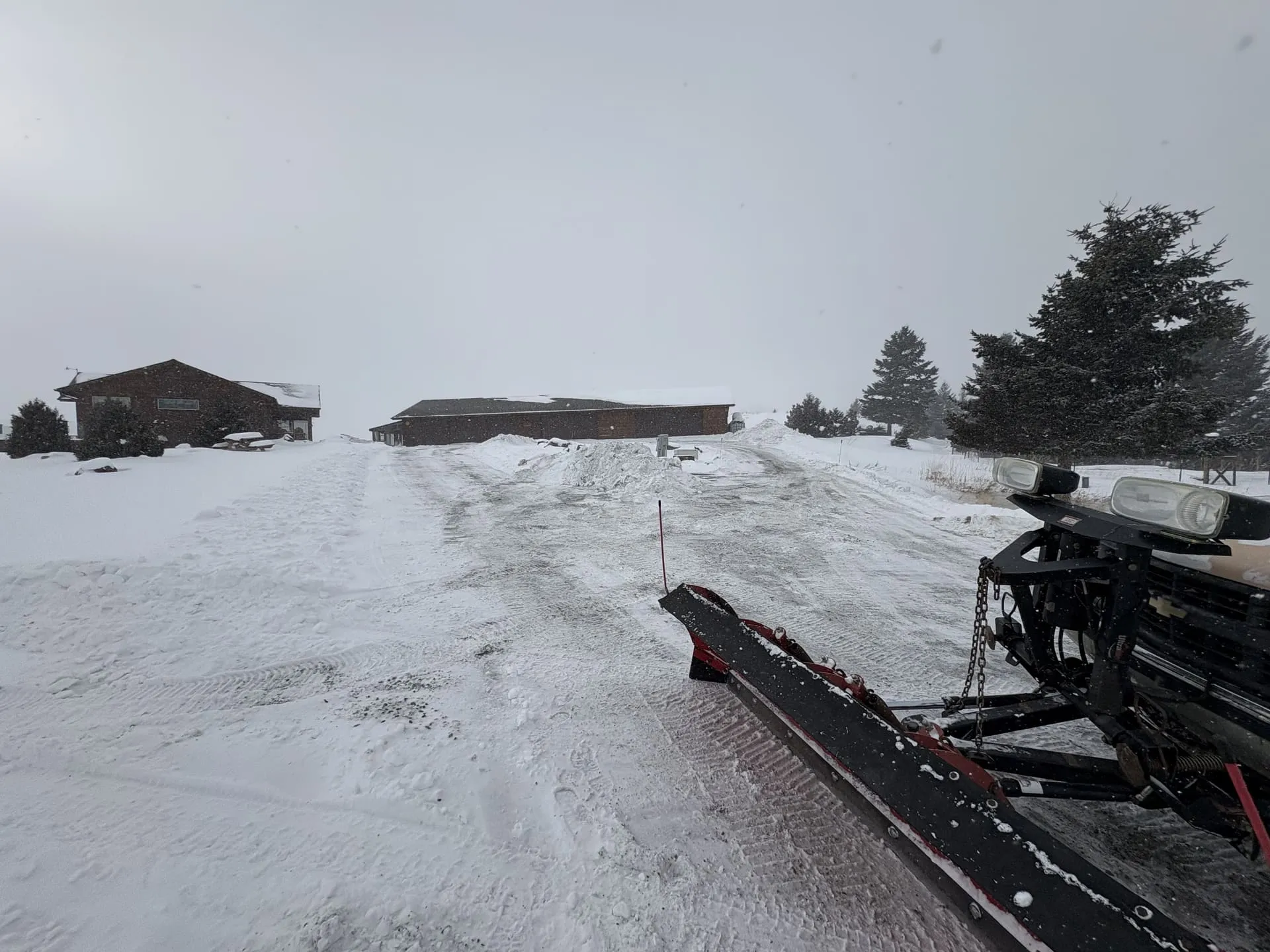 At elevation, snow isn’t an event the structure survives — it’s a load the structure lives under for months.
Roof shed: the load nobody budgets for
Here’s the one that catches people, and it’s specific to mountain building.
Metal roofs shed snow. That’s what they’re for, and it works — but it means that instead of snow accumulating gradually on the roof, a large mass of it releases at once and lands wherever gravity takes it.
If that’s your deck, then your deck isn’t carrying snowfall. It’s carrying snowfall plus a roof’s worth of snow arriving as an impact.
That changes the design completely. There are several honest ways to handle it:
Don’t put the deck under the shed line. Simplest, best, and not always possible.
Add snow retention on the roof so it releases gradually rather than all at once.
Design the deck for it, which means heavier structure in that zone.
Protect the deck with a roof or cover of its own — which then has to be designed for the same load, so this solves a problem by relocating it.
What doesn’t work is ignoring it. And it’s not only a structural concern: a section of roof snow releasing onto a walkway or an entry is a genuine safety issue. Where snow comes off the roof is worth knowing before you decide where anything outdoors goes.
Railings in snow country
Railings take more abuse at elevation than people expect. Snow piles against them and stays there. Sliding snow pushes on them. Ice forms in and around them.
A few things follow from that. Railing infill that packs with snow and ice — tight horizontal patterns, dense mesh — is holding weight and staying wet. Cable railing keeps sight lines open, which is usually why people choose it up high, but its tension hardware wants checking as things freeze and thaw. Glass keeps the view and gets coated with snow and grime through winter, which is a maintenance reality rather than a defect.
The connection between railing post and deck structure is worth particular attention, because it’s carrying lateral force from snow in addition to whatever people lean on it for.
Ventilation and drainage underneath
Snow sitting on a deck for months means water underneath it for months, especially through the long melt.
A deck that can’t dry out underneath will rot in the framing, regardless of what the surface is made of. Composite boards don’t rot, but the wood holding them up absolutely does, and there’s a certain irony in a maintenance-free surface sitting on framing that’s quietly failing.
Airflow under the deck matters. So does what happens to melt water when it lands. Water running off a deck and pooling against a foundation is a worse problem than anything happening on the deck itself.
The short version
At elevation, a deck is a structure that spends much of its life under sustained load, gets hit by snow released from the roof, sits on ground that freezes deep, and stays wet through a long melt. It has to be designed for all four.
That’s why we ask about elevation, aspect, roofline, and where snow comes off before we talk about railing style, and why a mountain property deck is not a valley deck with a better view.
If you’re building around Big Sky or anywhere up the canyon, this is the first conversation worth having, and it’s worth having with someone who has built in it.
When you’re ready: plan your deck project and we’ll look at the roofline, the aspect, and the ground before we design anything. Free measurements across Gallatin and Park counties.