It depends on the fence. Wire fences typically put line posts somewhere around 10 to 20 feet apart, with mesh on the tighter end and barbed wire with stays on the wider end. Rail, board, and jackleg fences don’t get a choice: the rail length sets the spacing, commonly around 8 to 10 feet. The ranges below are typical, not code, and the ground on your line decides the final layout.
Here’s how we think about spacing when we stake a line, and why it matters less than most people think.
The short answer
- Barbed wire: typically around 12 to 20 feet between line posts, wider with stays.
- Field fence or woven wire: typically around 10 to 16 feet.
- No-climb horse fence: typically around 8 to 12 feet.
- Split rail, round rail, ranch board: set by rail or board length, commonly around 8 to 10 feet on center.
- Jackleg: buck spacing set by rail length, commonly around 8 to 12 feet.
- Pipe and continuous panel: set by rail or panel length, tighter in pens and corrals.
- Corners, ends, and gates matter more than any of these numbers. That’s where fences fail.
Typical post spacing by fence type
| Fence type | Typical line post spacing | What sets it | Montana note |
|---|---|---|---|
| Barbed wire | About 12 to 20 ft; wider with stays | Wire tension, stays, terrain | Add posts at every rise and dip so wire stays at height |
| Field fence / woven wire | About 10 to 16 ft | Mesh weight, stock pressure | Mesh catches drifting snow; tighter spacing in drift zones |
| No-climb horse fence | About 8 to 12 ft | Keeping mesh tight against leaning horses | Often paired with a top board or rail |
| High-tensile smooth wire | Often wider than barbed wire; varies widely | Wire, stays or spacers, terrain | Needs the strongest end bracing of any wire fence |
| Split rail | Commonly 8 to 10 ft | Rail length | Set posts suffer frost heave; depth matters |
| Round rail / ranch board | Commonly 8 to 10 ft on center | Rail or board length, joints on posts | Long rails carry snow load; shorter spans sag less |
| Jackleg (buck and rail) | Bucks commonly 8 to 12 ft apart | Rail length and lap | No set posts, so frost and rock aren’t a problem |
| Oil field pipe | Commonly 8 to 12 ft | Pipe rail length, stock pressure | Tighter in corrals, bull pens, and alleys |
| Continuous panel | Set by panel length | Panel joints | Posts at joints; extra support where stock push hardest |
For comparison, Montana’s legal fence statute, MCA 81-4-101, sets its own maximums for a legal fence: for barbed wire on well-supported leaning posts, not exceeding 20 feet apart, or 33 feet apart where two or more stays or pickets are used equidistant between posts; for woven wire, posts not more than 30 feet apart; and for boards, rails, or poles, posts not over 17 feet 6 inches apart. Those are legal thresholds for holding range stock, not a recommendation. A working fence on Montana ground usually ends up tighter.
Wire fences: barbed, field fence, and no-climb
Barbed wire is the most forgiving about spacing because the strands are light and catch little snow. Line posts typically land around 12 to 20 feet apart. Twisted wire stays between posts hold the strands at even spacing so stock can’t spread them, which is what lets the posts go wider. Our take on where barbed wire still fits covers the cases where a different fence is the better call.
Field fence (woven wire) is heavier, catches drifting snow, and gets leaned on by cattle. Typical spacing runs around 10 to 16 feet. With bulls or heavy pressure, tighter spacing earns its keep. Our field fence guide covers mesh and height by animal.
No-climb horse fence is mesh with small openings, built so horses can’t get a hoof through. Horses lean, rub, and reach over, and a mesh that loosens becomes a hazard, so posts typically sit around 8 to 12 feet apart and the mesh is stretched hard between solid ends. See our notes on no-climb horse fencing.
High-tensile smooth wire can run wider spacing than barbed wire, with stays or spacers doing much of the work between posts. The tradeoff is end loading: high-tensile is stretched much tighter, so the corners and ends carry more pull than on any other wire fence.
Line posts vs. stays
A line post goes in the ground and holds the fence up. A stay (also called a dropper or batten) is a twisted wire or light picket fastened to the strands between posts. It hangs on the wire and keeps the spacing even.
Stays let you space posts wider on flat, even ground. They don’t replace a post where the line changes. Every top of a rise needs a post so the wire doesn’t pull down into the ground behind it, and every bottom of a dip needs one so the wire doesn’t lift away from the ground and leave a gap for calves, dogs, and coyotes. On rolling ground, the terrain sets more of the post locations than the tape measure does.
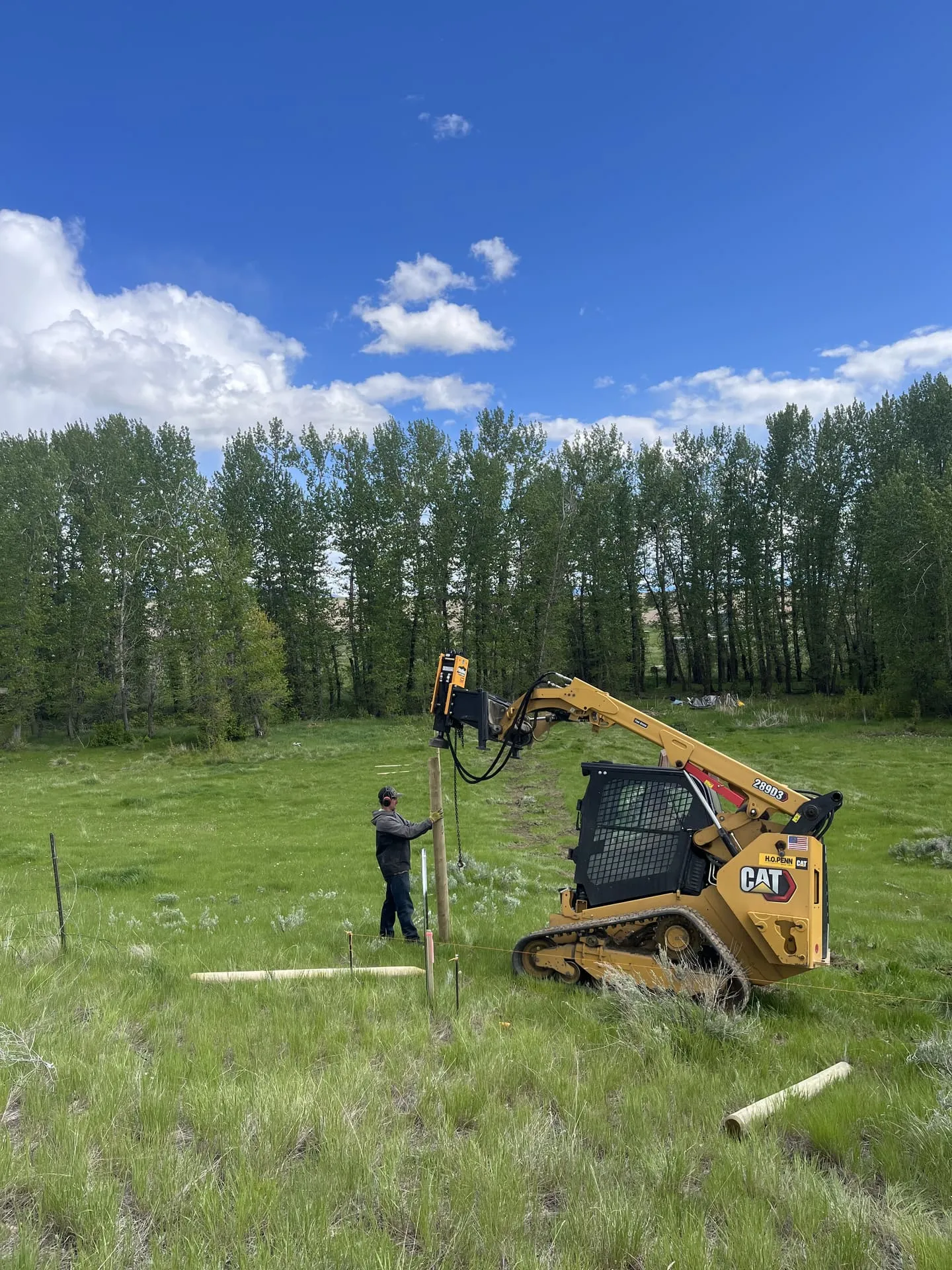 A string line and stakes set post locations before each post is driven.
Rail, board, and jackleg: the material sets the spacing
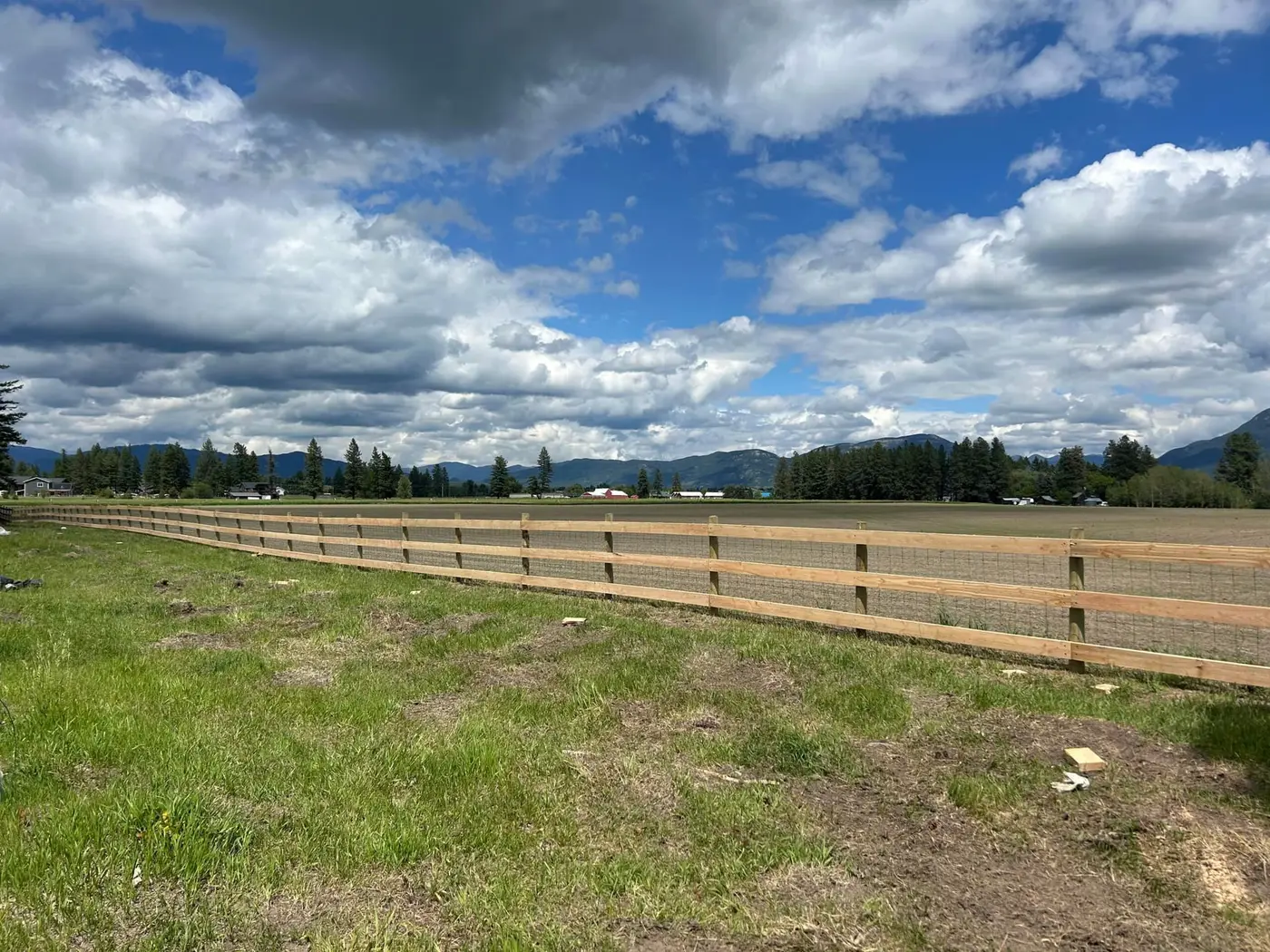
On split rail, round rail, and ranch board, posts go where the rails end, so spacing is fixed by what you buy. Board fences typically put joints on posts and stagger them from one board to the next so no single post carries every joint. Rail fences mortise or lap the rails at the posts. Either way, the material length decides the layout, commonly around 8 to 10 feet on center.
Jackleg has no set posts. Crossed-leg bucks sit on the ground and rails lap between them, so buck spacing follows rail length and lap, commonly around 8 to 12 feet. Our jackleg vs. split rail comparison covers where each one fits.
Pipe and continuous panel follow the same logic: the rail or panel length sets the spacing, and pens, alleys, and corrals get tighter spacing and heavier posts because that’s where stock push hardest.
Why corners and braces matter more than line spacing
Line posts only hold the wire up. Corner, end, and gate posts hold it tight, and they carry the whole tension of every run they anchor, through every temperature swing, for the life of the fence. Get line spacing a few feet off and the fence sags a little between posts. Get the corners wrong and the fence fails.
That’s why we spend more time on corners and H-braces than on spacing:
- Every corner, end, and gate gets a braced assembly. On wire fence that’s usually an H-brace: two posts, a horizontal brace near the top, and a diagonal brace wire.
- The brace has to be long enough. A common rule of thumb is a horizontal brace at least about twice the fence height, which is part of why 8-foot braces are so common on wire fence.
- Long or heavy pulls get a double brace. Woven wire, high-tensile, and long straight runs often need two braced spans in a row, and very long runs get a braced assembly partway along.
- Grade changes count. A sharp break in slope puts sideways load on the line, and sometimes needs bracing too.
Montana factors that change the spacing
Snow load. Drifts sit on rails and push on mesh. A shorter span deflects less, so lines that drift every winter often get tighter spacing, or a fence type that lets snow pass through.
Frost heave. Spacing doesn’t fix frost. Depth and how the post is set do. Freeze-thaw lifts posts that aren’t set deep enough in undisturbed ground, and a heaved corner loosens the whole run. Our guide to how fence posts are set covers driven, augered, and concrete posts.
Rock. When a post won’t go where the string says, line posts can usually shift a little either way. On solid ledge, the design often changes to jackleg.
Slopes. Posts land at every rise and dip, which usually means more posts than the same footage on flat ground.
Wind. Strands and rails let wind through. Mesh packed with snow, and solid fences, catch it, so spacing and post size go up with exposure.
Livestock pressure. Bulls, stallions, weaned calves, and crowded pens need tighter spacing and stronger posts than a back-pasture boundary. Where elk and deer cross, height and wire choice matter as much as spacing.
When you want to see how a layout adds up, sketch it in the fence line measurer to count footage, corners, and gates, then start a fence estimate or call (406) 551-6772. We’ll walk the line and set the spacing for your ground.