Barbed wire built the American West, and it still fences more Montana acres than anything else. It’s cheap per foot, fast to run over long distances, and it holds cattle. For big open rangeland with cattle and not much else to consider, it remains a sensible tool. But barbed wire also gets used in a lot of places where it’s the wrong answer, and knowing the difference saves money, animals, and grief.
This is a straight look at where barbed wire fits, where it doesn’t, and what to reach for instead.
Where barbed wire still earns its place
Large cattle operations on open range. When you’re fencing a lot of ground, containing cattle, and counting cost by the mile, barbed wire’s economics are hard to beat. Cattle respect it, it covers distance quickly, and repairs are simple.
Boundary and perimeter runs on working ground where the fence’s job is to mark a line and hold stock, far from the house, gardens, and traffic.
Cross-fencing for rotational grazing where temporary or semi-permanent divisions move cattle between pastures.
In those roles, barbed wire is doing exactly what it was invented to do, and there’s no reason to overspend on something fancier.
Where barbed wire is the wrong choice
The trouble starts when barbed wire gets used out of habit in situations it was never suited for:
Horses. This is the big one. Horses and barbed wire are a dangerous combination, full stop. A spooked horse that hits barbed wire can suffer serious injuries, and vets in horse country see the results every year. For any horse fencing, the answer is no-climb mesh, rail, or board, never barbed wire. Our guide to no-climb horse fencing covers why.
Small livestock. Sheep, goats, and the like walk through, under, and around barbed wire. It simply doesn’t contain them, which is field fence territory.
Anywhere near people. Along driveways, homesites, gardens, and shared areas, barbed wire is a hazard and an eyesore. Kids, dogs, and guests don’t mix with it.
High-traffic wildlife corridors. Barbed wire, especially a barbed top wire, is hard on deer and elk. Animals clearing a fence catch a hind leg on the top strand and tangle, and the results are grim for the animal and the fence both. In migration country, a smooth top wire or a wildlife-conscious design matters, as we cover in wildlife-friendly fencing.
The alternatives, matched to the job
If barbed wire isn’t right for your situation, the good news is that Montana fencing has a deep bench:
- Mixed livestock or anything near horses: field fence or no-climb mesh, which contain far more than cattle and carry none of barbed wire’s injury risk
- Boundary or frontage where looks matter: split rail, jackleg, or rail, which read as Montana and coexist with wildlife
- Corrals and high-pressure pens: continuous steel panel or pipe fence, built to take real abuse
- Rocky or frost-prone ground where posts won’t set: jackleg, which needs no post holes at all
Many properties end up with a mix, and that’s the right instinct: barbed wire on the far cattle pasture, no-climb around the horse paddock, rail along the drive. The fencing comparison lays out which type suits which job.
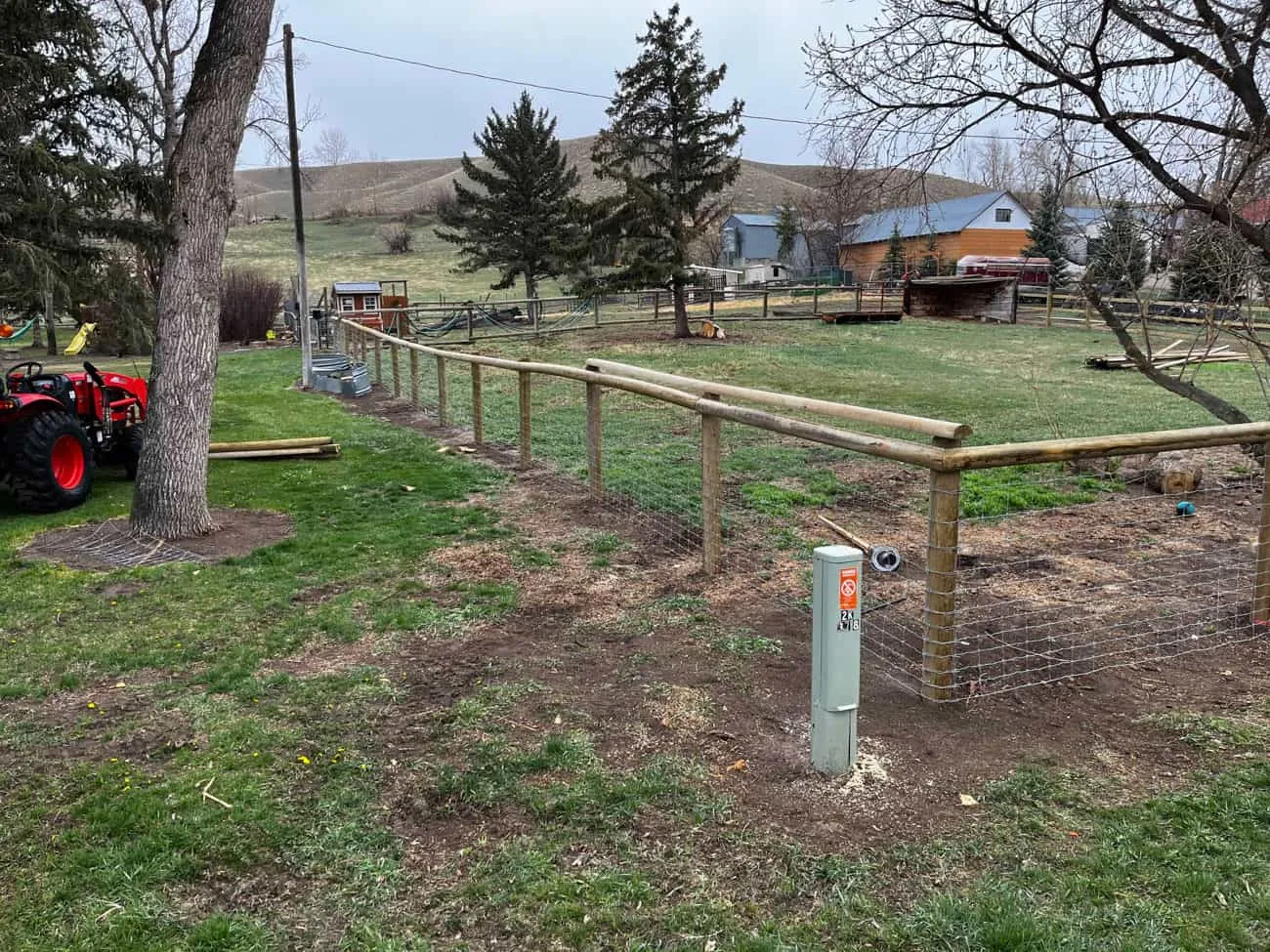 A wire fence line on working ground, where the job is holding cattle over distance.
A word on the old wire already on your place
Nearly every older Montana property carries derelict barbed wire somewhere: sagging lines in the willows, half-buried strands in the grass, an abandoned fence nobody’s touched in decades. That old wire is a genuine hazard to livestock and wildlife, and one of the most valuable things a landowner can do is get it pulled and hauled. When we replace a fence, removal and haul-off of the old wire is part of the job, and it’s work worth doing even where nothing new is going back in.
The bottom line
Barbed wire isn’t good or bad, it’s specific. For cattle on open range, it’s still a reasonable choice. For horses, small stock, people, and wildlife-heavy ground, it’s the wrong tool, and Montana has better options for every one of those cases. The right move is to match the fence to the actual job, animal by animal and section by section, rather than defaulting to what’s always been there.
Not sure which type your property needs? That’s a good place to start a conversation. Tell us what you’re containing and where, and we’ll recommend the right build for each stretch.
Ready to plan: start a fence estimate with free on-site measurements, or compare every option on the fencing hub.