An automatic gate earns its keep in Montana on exactly the nights you least want to leave the truck: wind at twenty below, snow sideways, a quarter-mile still to drive. That’s also precisely when a badly planned gate fails. The difference between the gate that works in February and the one that doesn’t is decided at installation, not at the keypad.
Here’s what actually matters for cold-country gate reliability.
The opener is only as good as its mounting
Gate operators are rated machines (swing arms, sliding drives, hydraulic and electromechanical designs) and quality units handle cold temperatures fine. What fails is everything around them:
- Posts and columns that move. Frost heave tilts a gate post an inch and suddenly the operator fights geometry all winter. Footings below frost depth are non-negotiable here, the same discipline that keeps our archways and stone columns plumb for decades.
- Sagging gates. A heavy steel gate that drops half an inch drags the operator with it. Heavy-duty hinges and serious bracing matter more in snow country because the gate also carries ice load.
- Poor drainage at the pivot. Water pooling at the base of the gate becomes ice at the base of the gate. Grade and drainage around the entrance are part of the gate design, not landscaping afterthoughts.
Power: grid, solar, or the practical hybrid
Grid power is the gold standard when the entrance is near existing service. Budget conversation shifts to trenching, and utility trenching across a long driveway is often the biggest single line in an automation project.
Solar has matured into a genuinely reliable option for remote entrances — with Montana caveats:
- Panel sizing must assume December sun, not July
- Battery capacity carries the system through storm weeks; cycles-per-day matters (a busy ranch gate works harder than a weekend cabin gate)
- Panel placement needs full winter sun and a snow-shedding angle
The hybrid truth: many “solar” installations succeed because they’re planned like off-grid power systems, not accessories. Sizing honestly beats wishing in January.
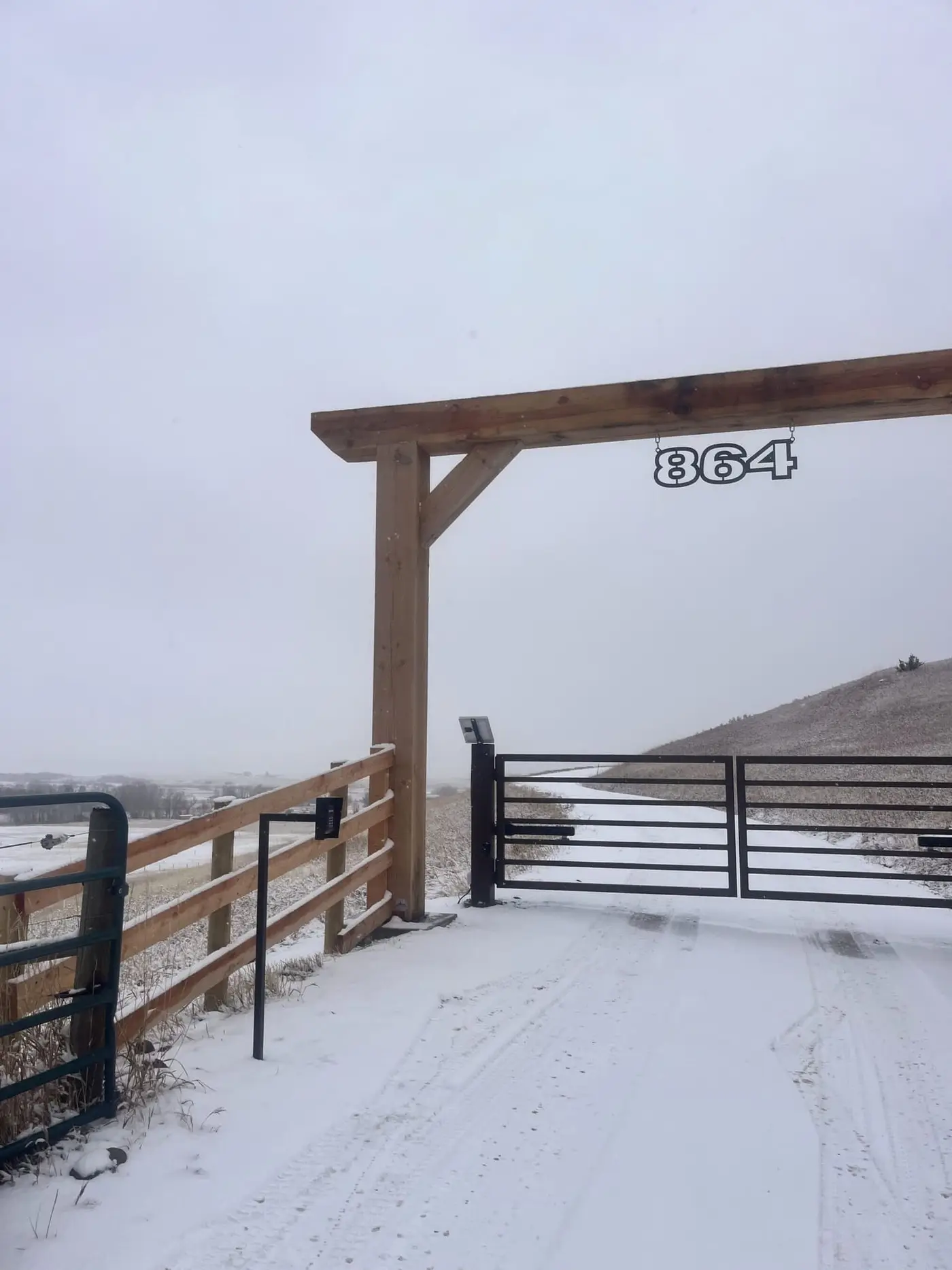
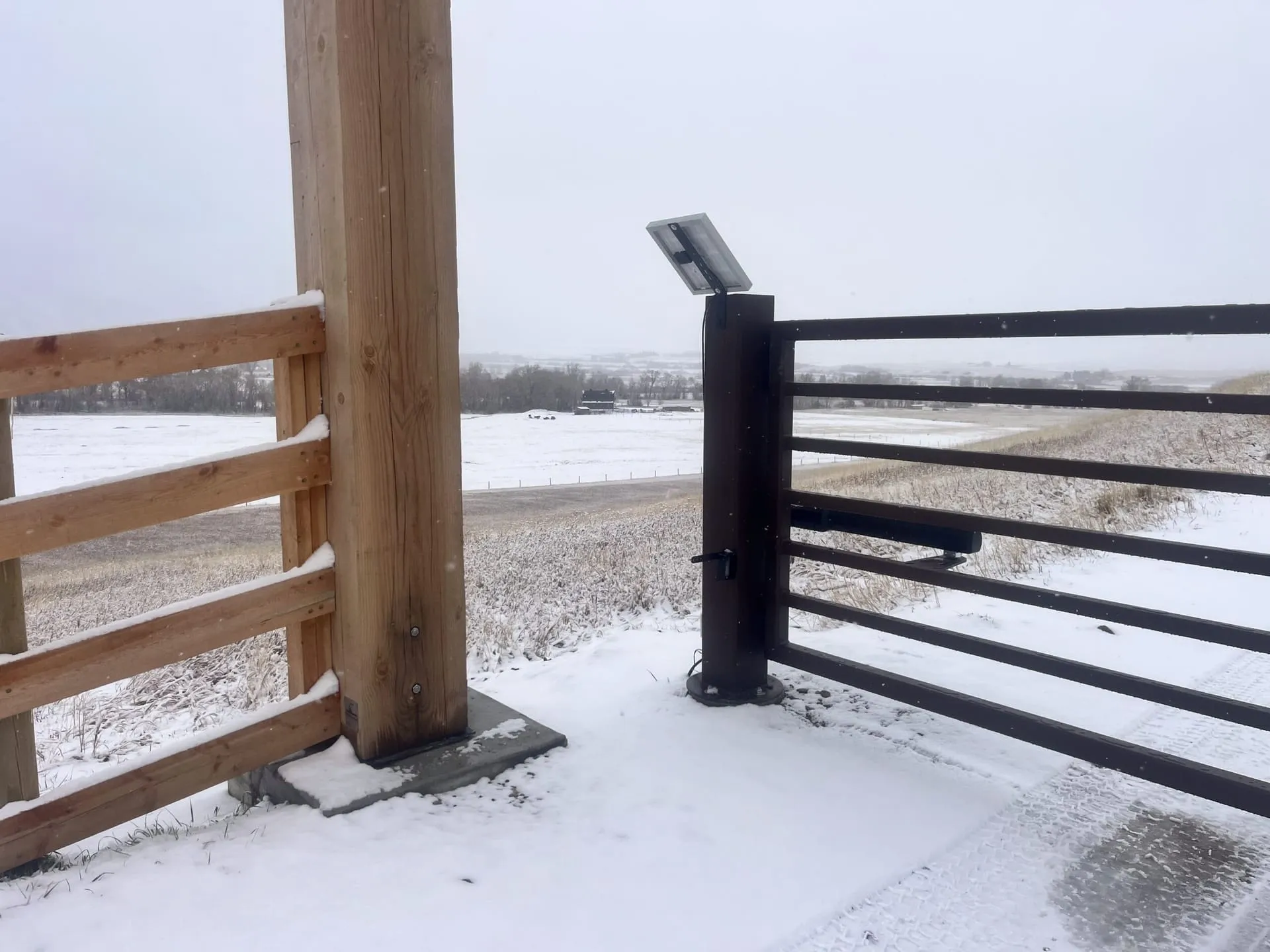 Decorative steel gate from the gallery — fabricated with its automation hardware planned, not retrofitted.
Access control that works with gloves on
Keypads, remotes, phone apps, vehicle sensors — all fine, until the temperature drops and the driver’s wearing gloves in the dark. Winter-practical setups usually layer:
- In-vehicle remotes for daily users (no window rolled down into the wind)
- A keypad mounted at true driver height on the approach side, lit, for guests and deliveries
- Phone/intercom access for the deliveries you didn’t expect
- A manual release the whole family knows how to use — power failures happen in exactly the weather where you least want to climb the fence
Snow is a design input
- Swing gates need their full arc plowed. A gate that opens into the drift line is a manual gate from December through March.
- Slide gates shrug off arc problems but need their track path cleared and their rollers kept clean of ice
- Clearance under the gate has to survive plowed berms — coordinate the gate design with whoever plows the driveway, because the plow and the gate share territory all winter
- Cattle guards pair beautifully with automatic gates on working ranches — stock stays put even while the gate cycles; see our cattle guard planning guide
Swing, slide, or cantilever: matching the gate to the entrance
Before the power and access questions, there’s a shape question, and your entrance usually answers it for you. The three common automatic gate styles each suit different sites:
Swing gates are the classic ranch look and the simplest mechanically, hinging open like a door (single) or a pair (double). They want level ground and clear arc space, since the gate sweeps through a quarter-circle that has to stay unobstructed. Their Montana weakness is snow: the arc has to be plowed, and a gate that opens into the drift line becomes a manual gate from December to March. On a flat, well-drained entrance with room to swing, they’re hard to beat for looks and value.
Slide gates roll sideways across the opening on a track or, in cantilever form, on rollers with no track touching the ground. They shine exactly where swing gates struggle: tight setbacks with no room for an arc, sloped approaches, and heavy-snow entrances where clearing a swing path is a losing battle. The tradeoff is that they need clear space to one side for the gate to retreat into, and the track (on tracked versions) has to be kept clear of ice and debris.
Cantilever slides are the premium answer for snow country, since nothing rides on the ground to freeze or clog. They cost more and need room alongside the opening, but on a serious winter entrance they’re often the most reliable choice.
The quick logic: flat with swing room and moderate snow, go swing; tight, sloped, or snow-heavy, look at a slide or cantilever. It’s one of the first things we sort out on a site walk, because the gate style shapes the posts, the power, and the snow plan that follow.
Buy the entrance, not just the operator
The gates that look right in ten years were planned as entrances, not as hardware bolted to whatever was there. Gate weight, archway clearance for stock trailers, column strength, wire runs, drainage, and the entrance design itself interact — which is why we build them as one system. An automatic entry gate with timber archway near Livingston in our project gallery shows the integrated approach: gate, arch, and approach engineered together.
Five gate mistakes that surface in February
- Solar sized for summer. The panel that kept the battery happy through August quietly loses the arithmetic in December’s short, gray days. Winter insolation is the design number.
- Keypad on the wrong side of the window. Mounted for a pedestrian, or on the far side of the lane, or at SUV height when the ranch runs pickups — every approach becomes a seatbelt-off gymnastics event.
- No manual release plan. The power fails during the storm, not on a nice day. If only one person knows where the release is (or it’s padlocked with a key in a kitchen drawer) the gate becomes a wall.
- Ignoring the plow. Gate arcs, keypads, and control posts placed without asking “where does the berm go?” get buried by January and hit by March.
- Light-duty everything. The opener rated “up to” your gate’s weight, hinges from the farm store bargain bin, a post set in a bag of concrete — cold amplifies every marginal component. Winter is a load test you’ve already scheduled.
Pre-estimate checklist
- How far is the entrance from grid power?
- Daily cycles — working ranch, family home, or occasional-use property?
- Swing room or slide track: where does snow actually pile at your entrance?
- Who needs access, and how (family, hands, deliveries, guests)?
- Existing posts/columns, or full entrance build?
- Trucks and trailers: what has to clear the opening?
Start the conversation: plan your automatic gate (we’ll evaluate power, snow, and access on-site) or explore complete ranch entrances if the gate is part of a bigger statement.