A cattle guard is the rare piece of ranch infrastructure that eliminates a chore entirely. No stopping, no gate swinging in the wind, no “who left it open”, vehicles roll through, stock stays put. When one is installed correctly at the right spot, it disappears into daily life. When it’s installed wrong, it announces itself constantly: rattling, shifting, filling with gravel, and eventually letting a cow teach everyone what “guard” was supposed to mean.
Here’s what separates the two outcomes.
Where cattle guards earn their place
The math is simple: frequency of crossing × annoyance of stopping. Guards make sense at:
- Main driveway entrances on working ranches, every trip, both directions, all year
- Boundaries between pastures crossed by ranch roads: where feeding and checking stock means multiple daily crossings
- Shared or long private roads where multiple users can’t be trusted to close gates (they can’t)
- Paired with automatic gates at entrances that want both stock control and access control, the guard handles animals, the gate handles people
Where they don’t fit: crossings that see occasional traffic (a gate is cheaper and simpler), horse-heavy traffic routes (riders need a gate or bypass anyway), and locations where small livestock (sheep, goats) defeat standard guard spacing.
Placement decides performance
Terrain and drainage first. A guard sits in a pit, and a pit collects water. Placed at a low point, it fills with runoff, silt, and then ice; the guard quietly stops working sometime in year two. Slight rises with drainage away from the pit are ideal, the same logic as road drainage generally.
Approach geometry. Vehicles should cross straight and level. Guards on curves or grades get corner-loaded by every crossing, which works the frame loose and chews the base.
Fence tie-in. A guard is a hole in the fence, structurally; wings and fence connections on both sides must guide stock to face the guard, not find its edges. That junction detail is where our fencing and guard work overlap constantly.
Winter reality. Packed snow can bridge a guard and turn it into a walkway. On year-round stock ground, plan for clearing or for a winter gate alternative — a consideration that belongs in the snow plan, not in the February surprise.
The invisible part matters most: the base
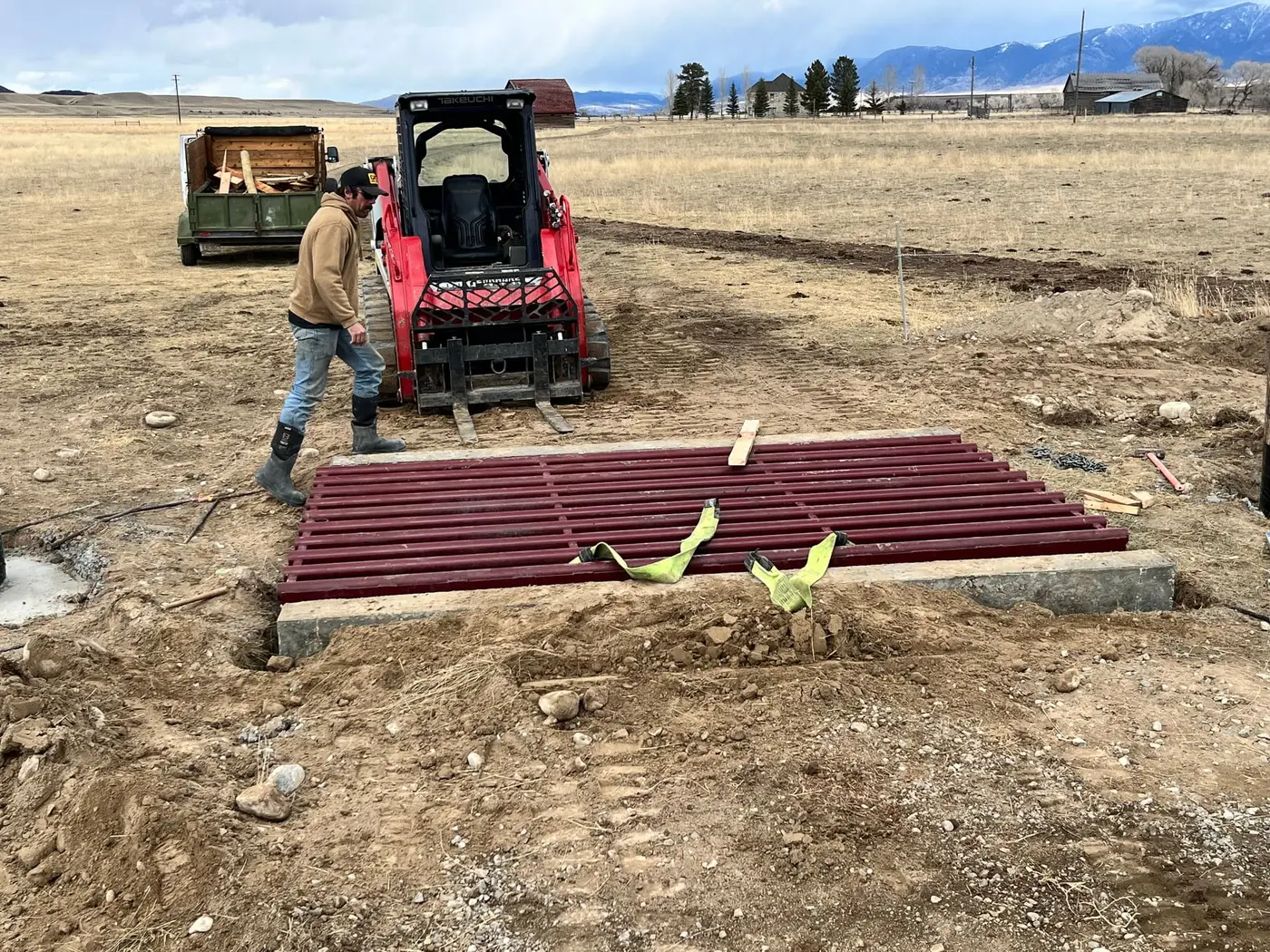
A cattle guard is a small bridge, and it’s only as good as its foundation:
- The pit needs excavation to proper depth with a base that drains — standing water under a guard is the fast track to frost trouble
- Concrete footings or engineered rail foundations carry the load of every vehicle, including the loaded hay truck and the occasional concrete truck
- Frost movement under an unfooted guard racks the frame; Montana’s freeze-thaw makes shortcut installs temporary by definition
This is also why guard removal is a real project rather than a lift-and-go: our cattle guard service handles both directions — new installs with proper excavation and bases, and removals where a property’s use has changed, with the pit backfilled and compacted so the road doesn’t remember it.
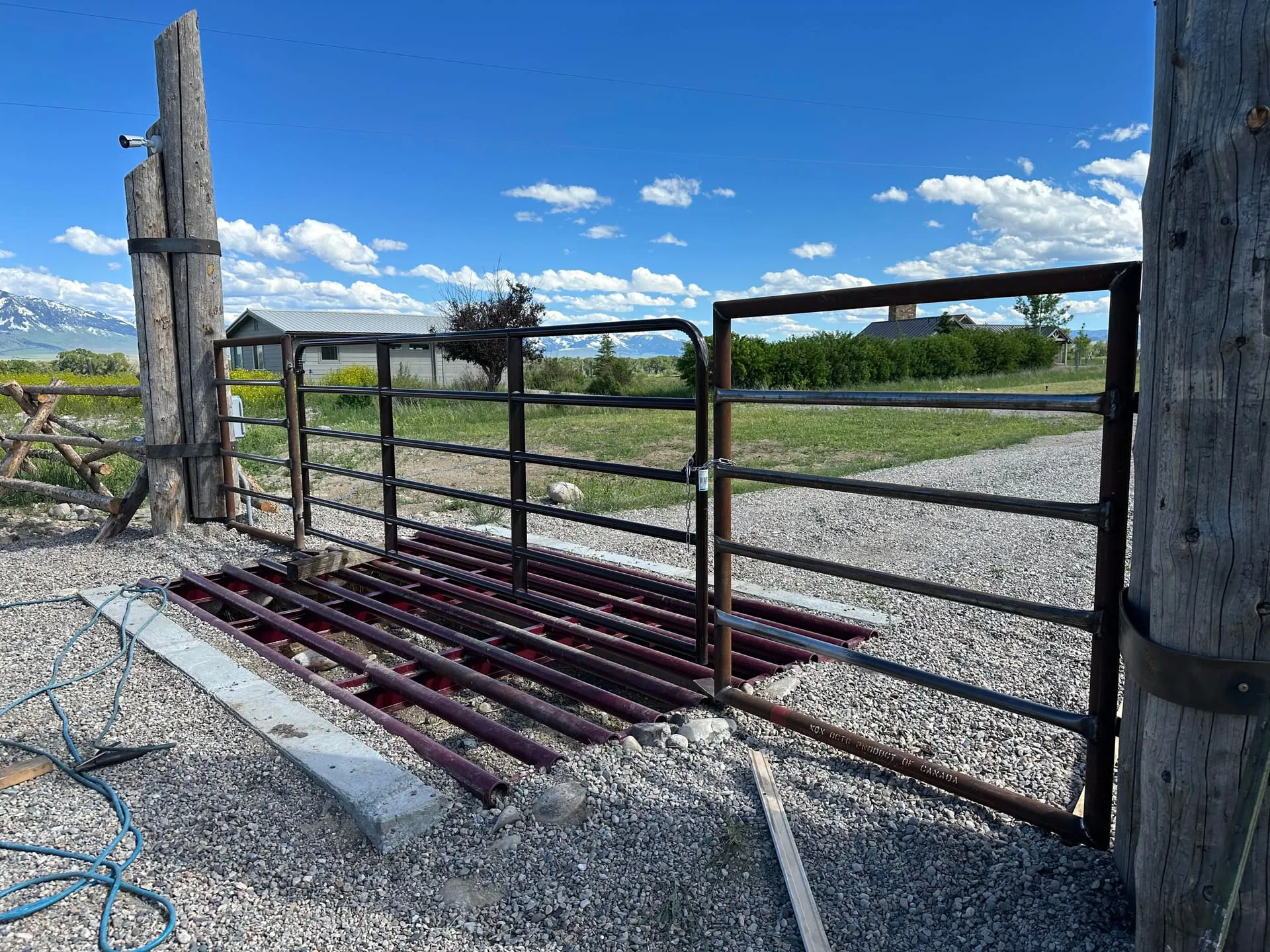 Guard, base, and fence tie-ins from the company gallery — the system, not just the steel.
Install, removal, or relocation?
Property uses change. Common scenarios we see:
- New install: stock operation expanding, new pasture road, entrance upgrade with an automatic gate
- Removal: property transitioning away from livestock; the guard is now just a rough spot in the driveway
- Replacement: an aging or under-rated guard that predates today’s equipment weights
Each starts the same way — someone looking at the crossing, the drainage, and the fence lines together.
Cattle guard questions, answered plainly
Do they actually stop all livestock? Cattle and horses respect a proper guard reliably. Sheep and goats defeat standard spacing, and a determined animal on ice-bridged bars in winter is a known failure mode — which is why winter maintenance matters on year-round stock ground.
What load rating matters for a private ranch? Whatever the heaviest vehicle is — typically the loaded feed truck, gravel truck, or concrete truck during a future build. Rating for today’s pickup and discovering the limit during next year’s construction project is the expensive order of operations.
How long do they last? The steel outlasts nearly everything if the base stays sound and drained. Guards fail from below (undermined footings, silted pits, frost-racked frames) far more often than from above.
Can an existing guard be moved? Often, yes — if the frame is sound, relocation is mostly excavation and new base work at the destination. Whether it’s worth it against a new unit is a case-by-case call we make after looking at the frame.
Pre-project checklist
- What crosses here, how often, and how heavy? (Feed trucks and equipment set the load rating)
- Which livestock — and are any of them guard-defeating species?
- Where does water go at this spot in April?
- How does fence tie in on each side?
- Winter: cleared, gated alternative, or seasonal?
- New install, removal, or swap?
Put it on the calendar: Plan a cattle guard project — we’ll evaluate placement, drainage, and the fence tie-ins on-site. For the bigger entrance picture, see the gates and entrances hub or browse completed work.