Ask most people what a gravel road is made of and they’ll say gravel. Ask someone who builds roads for a living and you’ll get a longer answer, because a road that lasts is layers, each doing a different job, and the difference between a road you build once and a road you rebuild every spring lives almost entirely in the material choices you can’t see once it’s done.
If you’re planning a driveway or ranch road, or trying to understand why yours keeps failing, here’s what actually goes into the ground and why it matters.
A road is a system, not a surface
Picture a good gravel road as a stack:
- Subgrade: the native ground, shaped and compacted, that everything sits on
- Base rock: the structural, load-carrying layer
- Surface gravel: the wear layer you drive on and the only part most people ever think about
Skip or skimp on the bottom two and you’ve built a surface with nothing under it, which is exactly the road that turns to soup at spring thaw. The visible gravel gets blamed, but the failure is almost always in the layers below.
Subgrade: the foundation nobody sees
Before any rock goes down, the native ground has to be prepared. Topsoil and organic material come off first, because organics under a road act like a sponge, holding water and rotting into a soft layer that swallows everything above it. The exposed subgrade then gets shaped to drain and compacted to carry load.
Where the native soil is soft or wet, this is also where a geotextile fabric often earns its keep. Laid between the subgrade and the base rock, it keeps the two from mixing, so your expensive base stone doesn’t slowly disappear down into the mud over the years. On good ground it may not be needed. On the soft spots, it’s the cheapest insurance in road building.
Base rock: where the strength lives
The base is the structural heart of the road. It’s typically a larger, angular crushed rock, placed and compacted in lifts, meaning layers, each compacted before the next goes on. Compaction is not optional here. Rock dumped and spread without proper compaction settles unevenly under traffic into the ruts and dips it was supposed to prevent.
Two things make base rock work:
- Angularity. Crushed rock has jagged faces that lock together, unlike smooth round river rock that rolls and shifts. Angular stone knits into a rigid layer.
- The right depth for the load and soil. A driveway for pickups needs less than a road that carries loaded hay trucks and the occasional concrete truck. Soft subgrade needs more base than firm subgrade. This is why depth is a judgment made on-site, not a universal number.
Surface gravel: the part you see
The top layer is the wear course, and it’s a different material than the base. Good surface gravel is a blend of stone and finer material, including a measured amount of “fines,” the sand and silt-sized particles that let the surface knit together, shed water, and grade smooth.
Fines are a balancing act. Too few and the surface won’t bind, so it stays loose and washboards. Too many and it turns greasy when wet and pumps mud up through itself. The right blend, often a product like a crushed base-course mix with proper fines, is what lets a road grade to a tight, smooth, shedding surface.
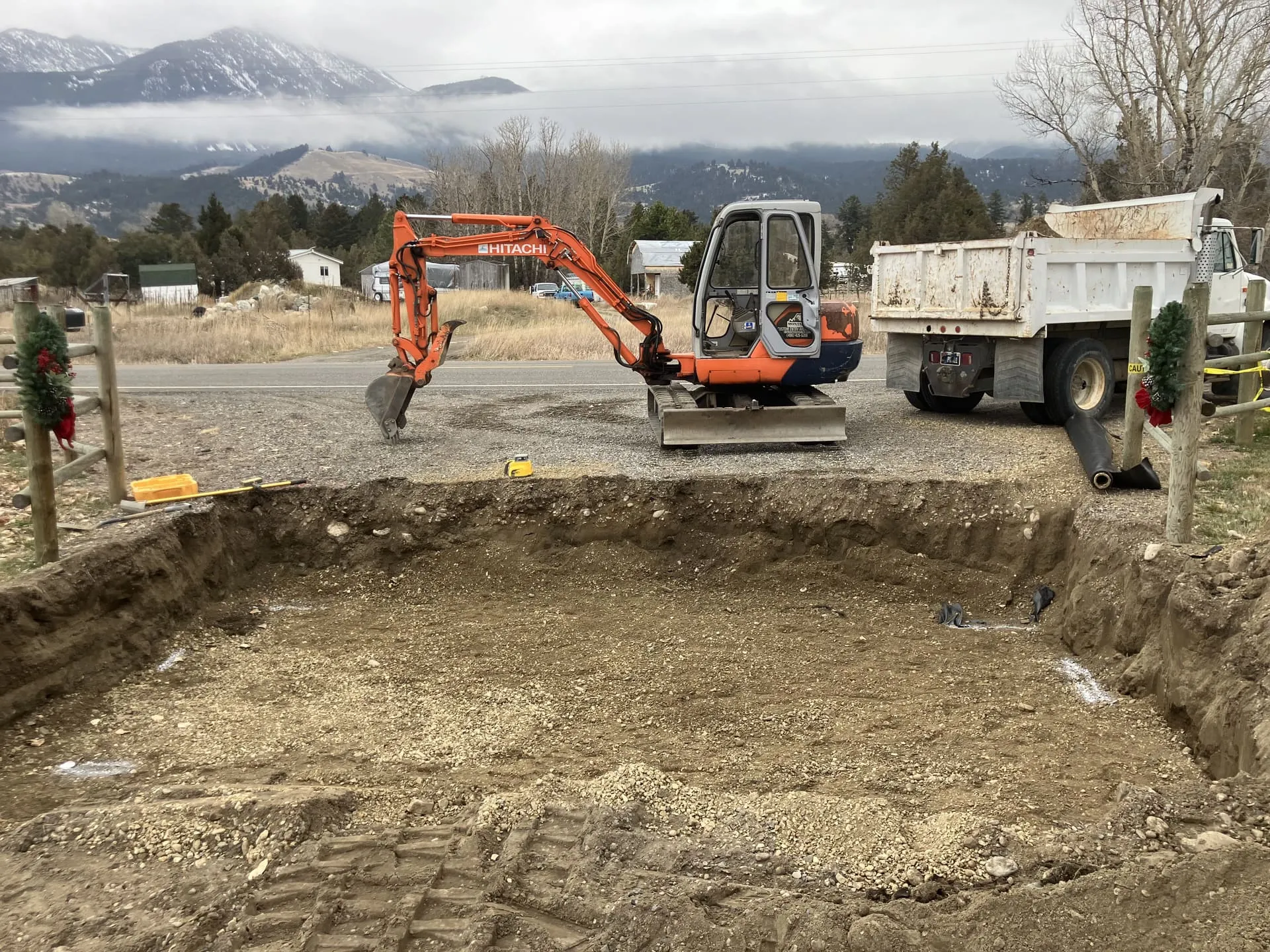 Earthwork and base preparation, the layers that decide whether a road survives spring.
Why “just add gravel” usually fails
The most common road mistake in ranch country is treating every problem as a gravel problem. A road pumping mud and rutting every spring has a base or drainage failure, and dumping fresh surface gravel on top is money poured into a hole, literally. The new rock sinks into the failed layer below, and next spring looks exactly like this one.
Knowing the layers helps you diagnose your own road. Surface problems, washboard, dust, minor potholes that grade out and stay out, are surface fixes. Recurring soft spots, mud pumping up through fresh gravel, and failures in the same places every year are base problems, which is the territory of our repair versus reconstruction guide.
How much gravel, and what about reclaimed base?
Two practical questions come up on nearly every road project: how much material it takes, and whether there’s a cheaper source than all-new crushed rock.
On quantity, the honest answer is that gravel is sold by weight or volume and adds up faster than people expect, because a road is wide, long, and layered. A useful mental model: every inch of depth across the width of the road, down its length, is real tonnage, and a proper road has several inches of base plus a surface course. This is why haul distance matters so much to the final number. Trucking rock from a far pit can rival the cost of the rock itself, and it’s a big reason two identical-looking roads can price differently. If there’s a usable gravel source on or near the property, that changes the math considerably.
On sourcing, there are legitimate ways to stretch a budget without cutting corners:
- Reclaimed or recycled base, such as crushed old asphalt or processed concrete, can make a sound, well-draining base layer at lower cost than virgin crushed rock, where it’s available and appropriate for the use.
- On-site material sometimes works. Native gravels, or rock pulled from a site excavation elsewhere on the property, can feed the road instead of a burn pile or a haul-off.
- Matching material to layer saves money. The expensive, well-graded surface mix belongs on top; the base underneath can often be a coarser, cheaper rock that does the structural job without the finish cost.
What doesn’t save money is buying too little and spreading it thin. A road built with half the base it needs isn’t a cheaper road, it’s a preview of next year’s rebuild. The right quantity, matched to your soil and traffic, is a number worth getting right on the first pass.
Drainage is the silent partner
No material choice survives bad drainage. A crowned surface that sheds water, ditches that carry it away, and culverts that move it under the road are what keep all these carefully chosen layers dry, and dry layers are strong layers. Water sitting on or in a road is what turns good base into bad base, which is why our drainage guide is really a road-longevity guide.
The short version: a road is an investment in layers, and the ones that matter most are the ones you’ll never see again after the job is done. Getting them right, matched to your soil, your traffic, and your water, is the difference between building a road and renting one from the weather.
Planning or fixing a road? Discuss your road project and we’ll evaluate the ground, the layers, and the drainage together. We build and rebuild private roads across Southwest Montana.