There are five common types of ranch gate: tube gates, pipe gates, wood gates, wire gates, and custom fabricated steel gates. Tube gates are light and quick to hang, pipe gates take abuse, wood gates match rail fence, wire gates close a gap in a wire fence, and custom steel gates are built to an exact opening with whatever design you want cut into them. Whichever you pick, the post it hangs on matters as much as the gate.
Here’s how each type works, where it fits on a Montana place, and what makes a gate swing true for decades instead of sagging by its second winter.
The short answer
- Pasture and hay ground: a tube gate on a well-set, braced post is hard to beat.
- Corrals, alleys, and anywhere stock push: a welded pipe gate.
- Next to rail or board fence where looks matter: a wood gate, or a steel frame with wood infill.
- A rarely used crossing in a wire fence: a wire gate.
- The main entrance, an odd-size opening, or a gate that will be automated: a custom fabricated steel gate.
What are the main types of ranch gates?
| Gate type | What it is | Best for | Watch out for |
|---|---|---|---|
| Tube gate | Light steel tubing in horizontal rails, sold in standard lengths | Pastures, hay fields, interior cross fences | Bends when a cow, horse, or tractor hits it |
| Pipe gate | Heavier pipe, welded, often matching pipe fence | Corrals, alleys, bull pens, high-traffic stock gates | Weight; needs a heavy, deep hinge post |
| Wood gate | Board or rail gate with a diagonal brace | Entrances and yards next to rail or board fence | Heavy per foot; racks and rots without good bracing and drainage |
| Wire gate | Barbed wire between stays, closed with a wire loop over a gate stick | Rare crossings in a wire fence | Hard to close tight; easy to leave down |
| Custom steel gate | Fabricated to the opening, with optional brands, silhouettes, or lettering | Main entrances, odd openings, automatic gates | Needs a post and footing sized for its weight and wind |
Tube gates
The tube gate is the one most people picture: horizontal rails of light steel tubing in a welded frame, the same style as a portable livestock panel. They’re sold in standard lengths, they’re light enough for one person to hang, and they’re the right answer for a lot of pasture and hay-field openings.
The trade-off is strength. Light tubing bends when a cow leans on it, a horse paws it, or a tractor tire catches the corner. In an interior pasture that sees a few openings a year, that rarely matters. In a corral it matters every day.
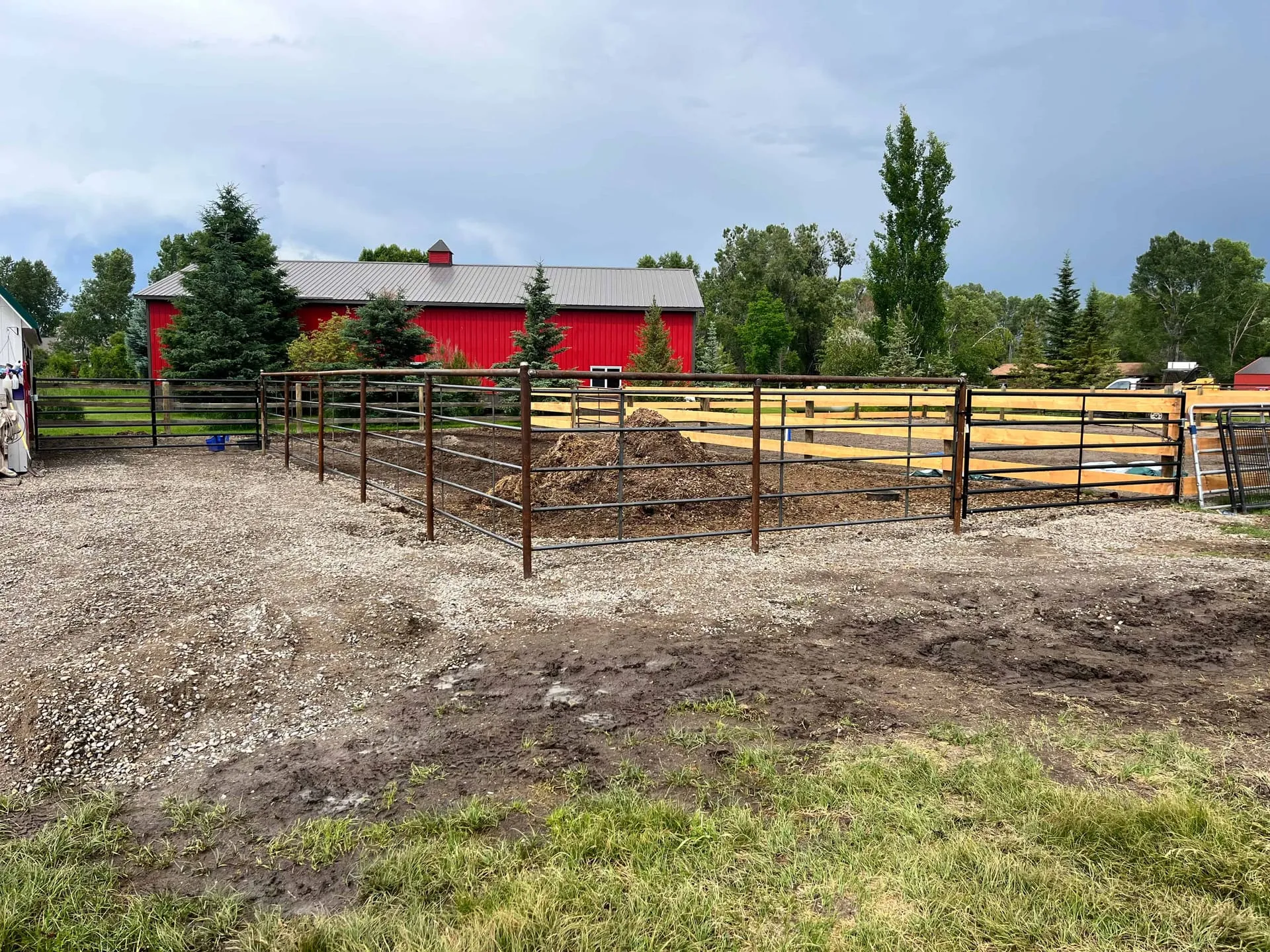 Tube gates hung on welded pipe posts in a corral. Light gates work here because the posts are heavy.
Pipe gates
A pipe gate is welded from heavier pipe, often the same material as oil field pipe fence and corrals. It holds up where stock crowd and push: sorting alleys, loading areas, bull and stallion pens, the gate the feed truck brushes every morning.
That strength comes with weight, and weight goes straight to the hinge post. A pipe gate hung on a post sized for a tube gate will pull that post over. On pipe fence the hinge post is usually pipe too, set deep and welded into the line so the whole run shares the load.
Wood gates
Wood gates suit entrances and yards where the fence is ranch board, split rail, or round rail and a steel gate would look out of place. They’re heavier per foot than tube gates and depend entirely on their bracing. The diagonal brace should run from low on the hinge side up to high on the latch side, so it holds the latch end up in compression. A wood brace set the other way does very little.
Keep the bottom rail up off the ground and out of standing snow, because wood that sits wet rots first. A common middle ground is a steel frame with wood boards bolted in: the look of wood, the stiffness of steel.
Wire gates and bump gates
A wire gate is a section of barbed wire stretched between wooden stays, with one end hooked over a gate stick at the post. It costs almost nothing, and on a back fence crossed twice a year it does the job. Its weaknesses are that it’s hard to close tight without a lever-type closer, and that people leave it lying in the grass.
A bump gate is a swinging gate that a vehicle pushes open with its front bumper; the gate swings around and closes behind it. They show up on ranch roads where nobody wants to get out of the truck. They need room to swing, ground that stays clear, and a driver who knows how to use one. Drifted snow and ice stop them, and in our climate an automatic gate or a cattle guard is usually the more reliable way to skip getting out.
Custom fabricated steel gates
A custom gate is built to the actual opening, grade, and hinge post instead of the nearest stock length. That’s the main reason to fabricate one: openings on older places are rarely standard. The second reason is character. Brands, initials, elk or horse silhouettes, mountain skylines, and lettering can be cut into steel panels or framed into the gate.
A few things change with a decorative gate. Solid panels catch wind, so on exposed ground a cut-through design lets air pass. A heavy decorated gate needs a heavier post and footing. And if the gate might be automated, the frame, hinges, and post get built for that from the start. Our ranch welding crew fabricates these in-house; the welding projects guide covers when to fabricate and when to buy stock.
Single or double leaf?
A single leaf is the simple option: one hinge post, one latch, nothing in the middle of the driveway for the plow to catch. It needs a full swing arc as long as the gate, and the longer the leaf, the harder it works the hinge post.
A double leaf splits the opening in two. Each leaf is shorter and lighter, so each hinge post carries less weight and less wind, and each needs less swing room. The cost is a center: a stop, a drop rod that sets into a socket in the ground, or a latch between the leaves. Drop-rod sockets fill with gravel and ice, and both leaves have to stay in line with each other, so frost movement shows up faster on a pair.
Swing direction and snow are their own decision, covered in swing vs. slide gates.
How wide should a ranch gate be for equipment?
Wide enough for the widest thing that will ever use it, plus room to steer. For a pasture gate that’s often the swather, the drill, a bale processor, or a tractor with a wide implement; many machinery gates end up somewhere in the 14- to 16-foot range, and plenty of operations go wider. A corral gate needs room to back a stock trailer square to it. A driveway gate has its own list, including hay trucks and fire apparatus, which we cover in driveway gate width and emergency access.
Measure your equipment instead of guessing. A gate that’s one foot too narrow gets clipped by every pass of the widest machine.
Why the hinge post does all the work
A swinging gate is a lever. All of its weight hangs off one side of one post, so the top hinge pulls away from the post while the bottom hinge pushes into it. Add wind on an open leaf, a kid riding the gate, or a cow rubbing on it, and that post carries far more load than any line post in the fence.
That’s why most sag is really post lean. A post that’s too small, too shallow, or unbraced slowly tips toward the gate, the latch end drops, and the gate starts dragging. In a wire fence the gate post should be part of a braced assembly. In pipe fence it’s welded into the line. Heavier gates need larger posts set deeper. Our post-setting guide covers the methods.
A few hanging habits help:
- Adjustable hinges on tube gates let you take out a little sag without resetting anything.
- Hang the latch end slightly high, so a little settling brings it level rather than low.
- Grease barrel hinges on heavy gates. A hinge that binds strains the post every time the gate moves.
Frost heave on gate posts
Frost heave is why a gate latches fine in August and won’t latch in January. Moisture in freezing soil forms ice lenses that lift whatever’s above them. If the hinge post and the latch post rise by different amounts, the latch stops lining up. In spring they settle back, often not quite where they started, and over a few winters the gate goes out of square.
The fix is a post set below frost depth with drainage that keeps water from collecting around it. Our guide to frost depth in Montana explains why this matters for every footing we set.
Latches and chains
Latches come down to who’s trying to open the gate.
- Chain and slot: a chain on the gate drops into a slotted keeper on the post. Simple, cheap, and forgiving when posts shift a little with frost.
- Spring or slide latches: one-handed and quick. Good on gates you open from a saddle or a four-wheeler.
- Two-way latches: for gates that swing both directions in a corral.
- Horse-proof latches: horses learn to lift simple latches. A latch that needs two motions, or a chain wrapped and clipped, keeps them honest.
- Lockable latches: for road frontage and gates you don’t want opened by strangers.
Keep latches and chain ends free of sharp points at animal height, and put them where you can reach them without climbing off a horse if that’s how the gate gets used.
What makes a gate automation-ready?
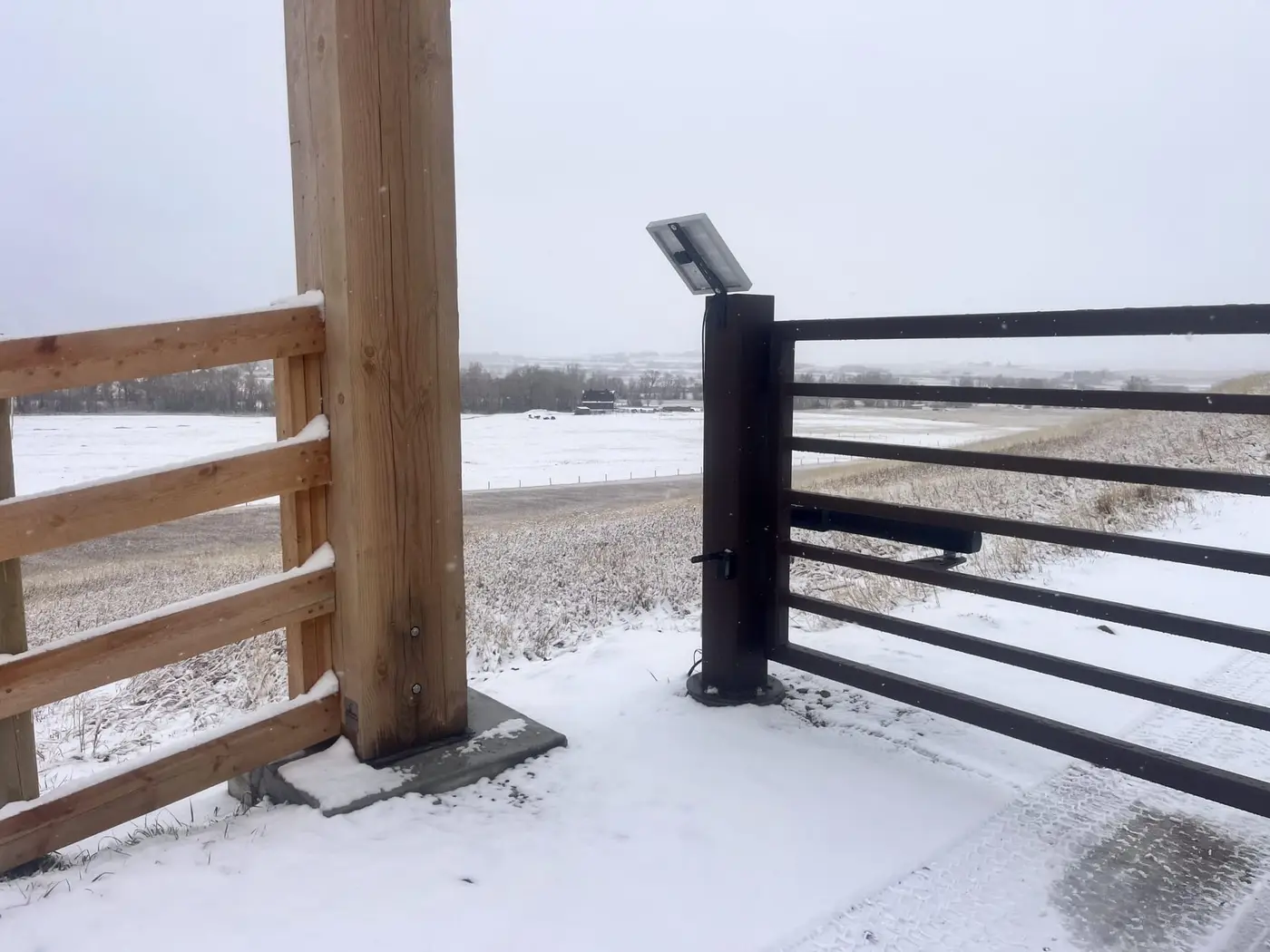
An operator needs a gate that’s stiff, square, and free-swinging. Flexible tube gates twist under an operator arm, and a gate that binds at the hinge makes the operator work at its limit. An automation-ready gate has a rigid frame, hinges that turn freely, a level hang, a post strong enough to carry the operator, and a plan for power or solar. Running conduit while the ground is open saves a trench later. We build automatic gates around exactly this.
If you’re sorting out which gate fits which opening, we can walk the fence line and the entrance with you and look at the posts, the ground, and the equipment that has to get through. Start a gate estimate or call (406) 551-6772.