A lot of the best entrance sites in Montana share a problem: they’re a long way from the nearest power. The ranch gate that would be perfect at the end of a quarter-mile driveway is also a quarter mile of trenching away from the grid. That’s the situation solar gate power was made for, and when it’s planned properly, it works beautifully. When it’s bought as an accessory and sized on optimism, it becomes the thing that strands you outside your own gate in January.
Here’s an honest look at where solar ranch gates make sense and how to plan one that actually runs through a Montana winter.
When solar is the right call
Solar shines, literally and financially, in a specific situation: an entrance far enough from existing power that trenching a line would be a major expense on its own. Running utility power across a long driveway means an excavator, a trench, conduit, and often the single biggest line in an automation project. If the entrance is remote, solar sidesteps all of that.
Good candidates:
- Remote ranch and recreational entrances with no power nearby
- Hunting and off-grid properties where grid service was never run
- Long driveways where the trenching cost to reach the gate rivals or exceeds the solar package
- Lower-traffic gates that cycle a reasonable number of times a day rather than constantly
The Montana catch: sizing for December, not July
Here’s where solar gates succeed or fail. A solar system is only as good as the sun it can count on, and Montana winter sun is a fraction of summer sun: short days, low angles, and stretches of overcast. A system sized to breeze through August can quietly run its battery flat in December.
The systems that work are planned like off-grid power systems, not like accessories bolted to a gate:
- Panel sized for winter, with the capacity to gather enough charge on short, gray days, not just long bright ones
- Battery capacity that carries the gate through storm stretches when the panel gathers little for days at a time
- Cycles-per-day counted honestly, because a busy ranch entrance works the system far harder than a weekend cabin gate
- Panel placement with full winter sun and an angle that sheds snow instead of collecting it, since a snow-covered panel gathers nothing
None of that is exotic. It’s just the difference between a system designed for the season it will struggle in versus the season it will coast through. The failures we hear about are almost always a system that was sized for the easy months.
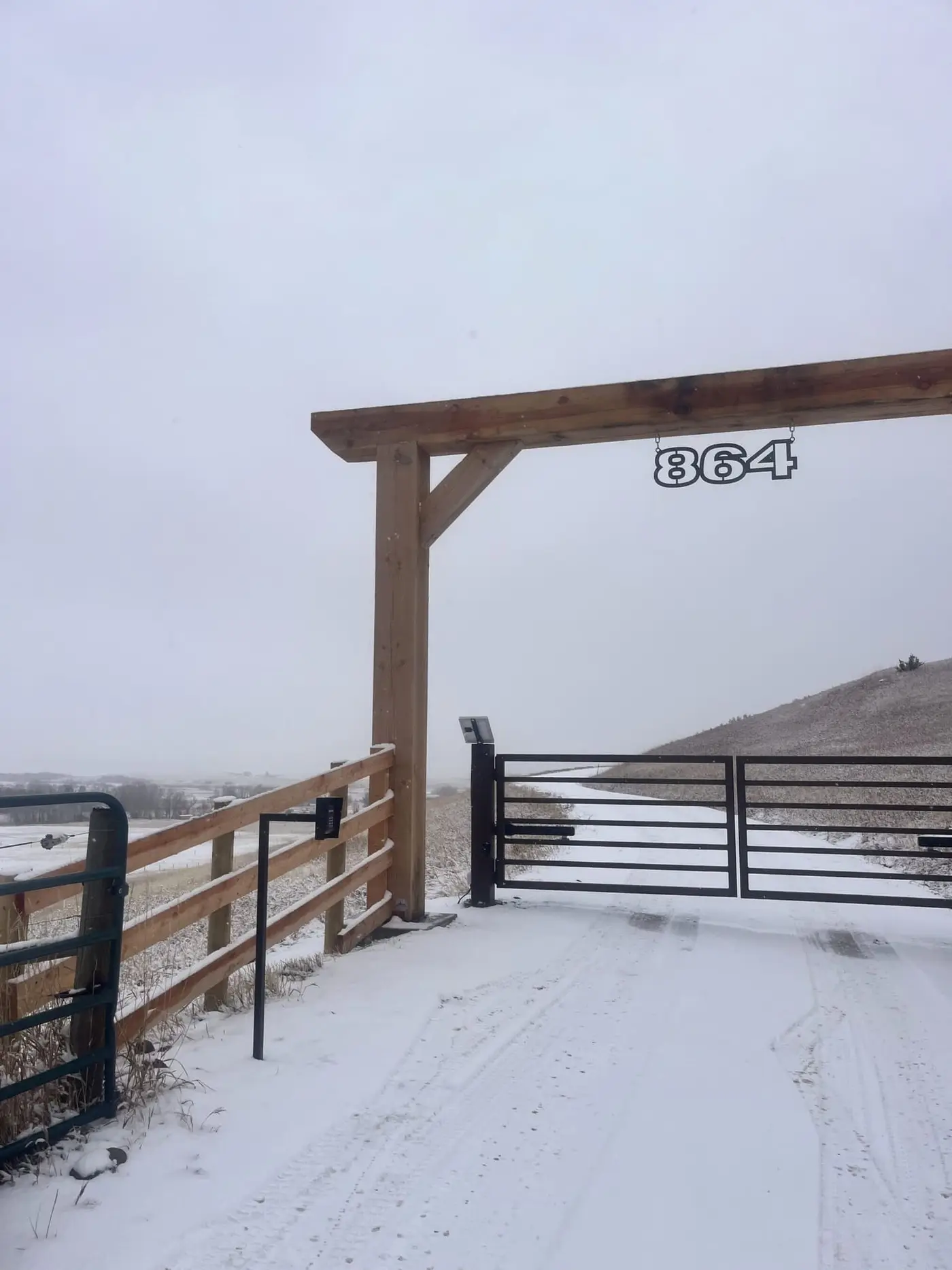
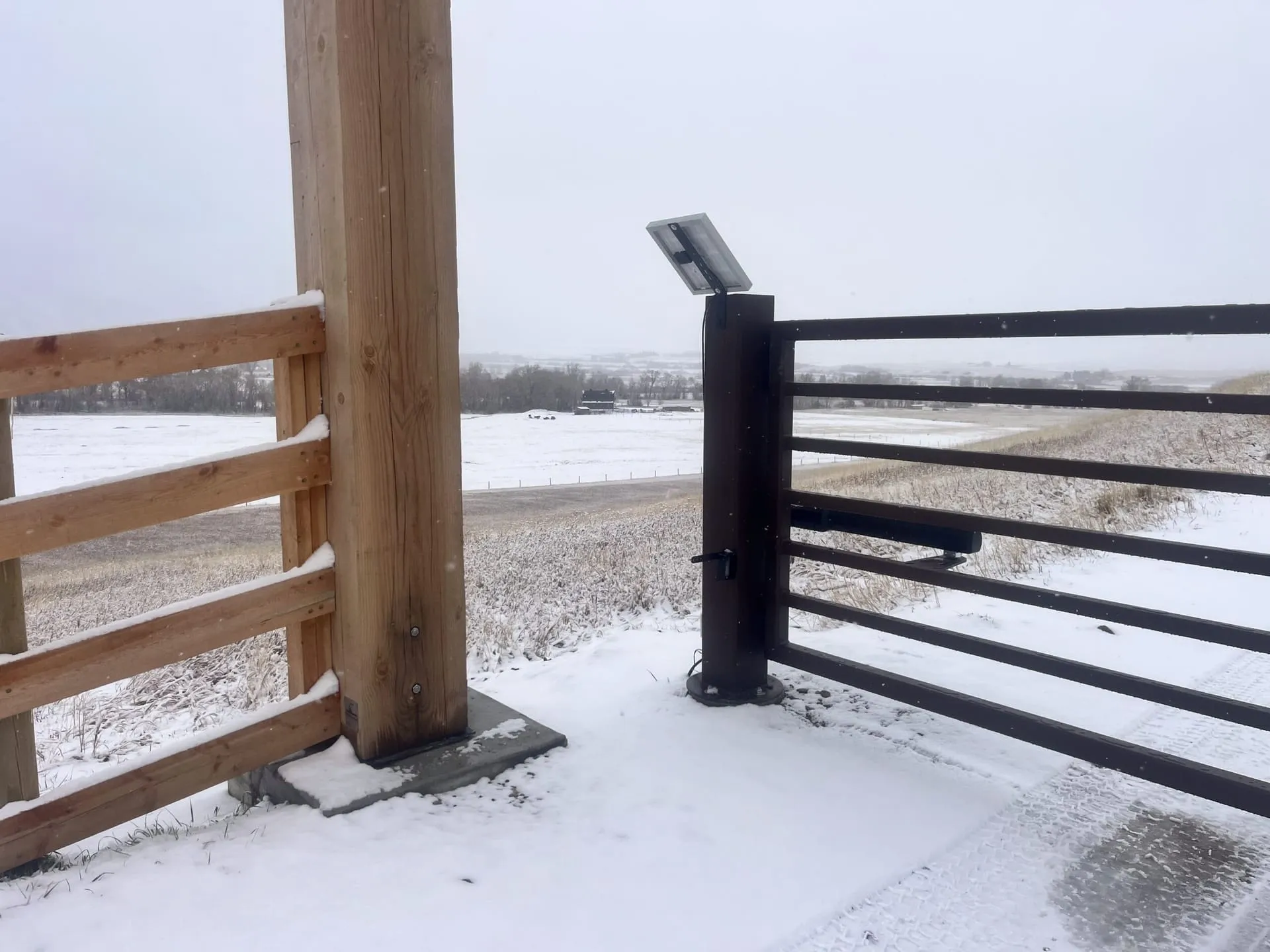 A remote entrance where solar power avoids a long trenching run to the grid.
The gate still has to be built right
Solar solves the power question, but it doesn’t change everything else that makes an automatic gate reliable in the cold, and those fundamentals still apply. The gate posts need footings below frost depth, because a heaved post fights the operator no matter how it’s powered. The gate needs heavy hinges and honest bracing to carry its weight plus winter ice. And the whole entrance needs a plan for snow, since a swing gate still has to clear its arc and a keypad still has to be reachable with gloves on. Our cold-weather gate guide covers those fundamentals in full, and they hold whether the power comes from a panel or a trench.
A manual release everyone in the family knows how to use matters even more on a solar gate, because the failure mode you’re planning against, a dead battery after a week of storms, tends to arrive in exactly the weather you least want to climb a fence.
Solar or trench? The honest comparison
The decision usually comes down to distance and use:
- Close to power, or high-traffic: a grid connection is often the more reliable long-term choice, with trenching as the main cost
- Remote, or trenching-expensive, with moderate use: solar, sized properly, is frequently the better economics and plenty reliable
- Either way: the gate, posts, footings, and snow plan are the same disciplined build
The worst outcome is a solar system chosen for its upfront simplicity and sized for summer. The best is one planned around the December it has to survive, on an entrance where avoiding the trench genuinely pays.
We plan entrances as complete systems, power included, and part of that conversation is an honest read on whether your site is a solar candidate or a trenching one. The entrance planning guide walks the rest of the decisions.
Plan your gate: tell us about your entrance and we’ll evaluate power, distance, and snow on-site. Free estimates across Southwest Montana.