The best way to choose a fence contractor in Bozeman is to ask the questions that decide whether the fence stands for twenty years: are they licensed with the state and insured, who actually builds it, how they set corners and posts in our rock and frost, and what the written estimate covers. A good contractor answers those plainly and puts them in writing. A contractor who can’t is telling you something.
Here’s what to ask, why it matters in Southwest Montana, and what a solid answer sounds like.
The short answer
- License: ask for their Montana construction contractor license or exemption certificate number, then look it up yourself.
- Insurance: ask for a certificate of insurance sent from their agent, not a photo of a card.
- Who builds it: find out whether their own crew or a subcontractor will be on your property.
- How it’s built: ask how corners, braces and gate posts are set, and what happens when they hit rock.
- Lines and locates: settle who finds the property line and who calls 811 before anyone digs.
- The estimate: get a written scope with measured footage, materials, gates, removal, cleanup and a realistic schedule.
Are they licensed with the state of Montana?
Montana switched systems at the start of 2026, so you’ll still hear the old term. Under House Bill 239, passed in 2025, the state’s construction contractor registration program became a Construction Contractor License administered by the Montana Department of Labor & Industry, starting January 1, 2026. Registrations active at the end of 2025 converted to licenses automatically.
Two things to know about it:
- Not every builder needs one. DLI’s notice says independent contractors with no employees are among those exempt. They often hold an Independent Contractor Exemption Certificate instead. A one-person outfit with an exemption isn’t doing anything wrong, but the exemption is tied to having no employees, so ask which one applies.
- It protects you in a specific way. Under MCA 37-45-202, if you hire a contractor who was licensed on the date of the contract, you aren’t liable as their employer for workers’ compensation, unemployment insurance, or their workers’ wages and benefits.
You can check any license in the state’s licensee lookup, linked from DLI’s Construction Contractor License program page. One limit worth knowing: DLI says it doesn’t evaluate workmanship when it handles licensing complaints. A license tells you a contractor is on the books, not that they build a good fence.
Ours is MT Contractor Reg #281253. Look it up the same way you would anyone else’s.
This is general information, not legal advice. For your situation, check with DLI or an attorney.
Are they insured, and for what?
The license application requires proof of workers’ compensation compliance. That’s not the same as general liability insurance, which covers damage to your property, your neighbor’s property, or a buried line. Ask about both.
The clean way to verify is to ask the contractor to have their insurance agent send you a certificate of insurance. It shows the carrier, the coverage types and the dates. If a contractor is vague about insurance, take that seriously, because a post through an unmarked water line or a skid steer into a neighbor’s gate is exactly when it matters.
Who will actually build the fence?
Plenty of good contractors use subcontractors. What you want to know is who will be on your property, who’s in charge of the crew day to day, and who you call when something comes up. If the person who walked the line with you won’t be there for the build, ask how the plan gets passed along. Details like “keep the bottom wire up for the deer” get lost in handoffs.
How do they build corners, braces and posts?
Ask this one directly. Corners and braces carry the tension of every run they anchor, and they’re where fences fail first. Our article on why fence corners and braces fail explains the mechanics.
Useful follow-ups:
- What kind of brace assembly at corners, ends and gates?
- How big are the corner and gate posts compared with line posts, and how deep do they go?
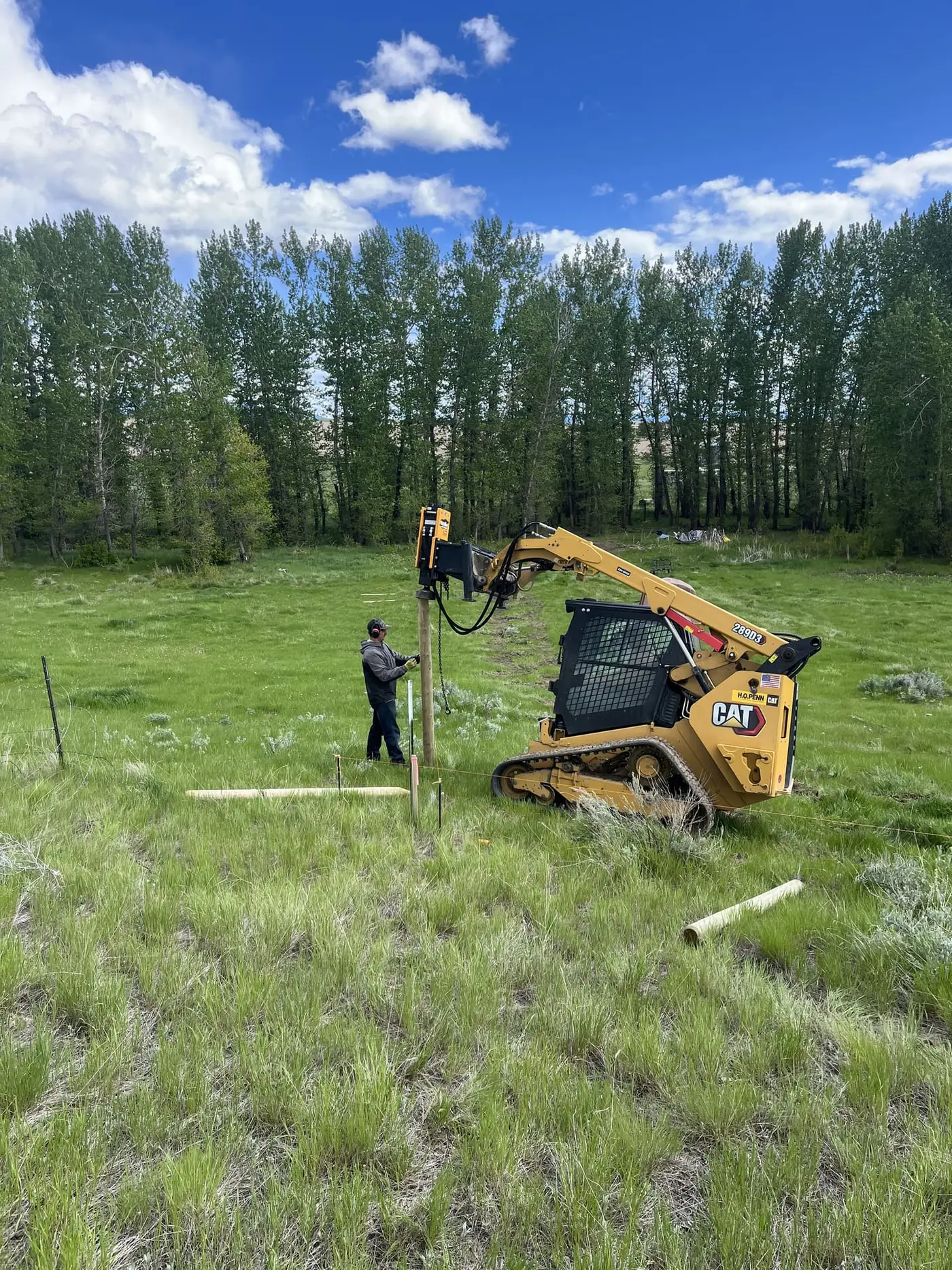
- Are line posts driven, augered or set in concrete, and why for this ground? (Our explainer on how fence posts are set covers the trade-offs.)
A contractor who has thought about it will answer quickly and explain the reasoning for your ground. “We do it the normal way” isn’t an answer.
How do they handle rock, slopes and frost?
The Gallatin Valley floor digs easily in places and turns to cobble a few hundred yards away. Benches and foothills around Bozeman, Livingston and Big Sky can be solid rock a foot down.
Ask what happens when a post won’t go: do they drill rock, move the post, switch a stretch to jackleg, or something else? And is that priced in the estimate or handled as a change? On slopes, ask whether rail fence will be stepped or follow the grade, and how wire will be kept tight through dips. For frost, ask how deep corner and gate posts go and how they keep them from heaving. Our frost depth guide explains why it matters.
What about elk, deer and other wildlife?
Around Bozeman and Paradise Valley, a fence is going to meet elk, deer, moose and sometimes pronghorn. A contractor who works here should ask what you want the fence to do with wildlife: let it pass, keep it out, or guide it. Wire heights, top-wire type and gate placement all change with the answer. Montana Fish, Wildlife & Parks publishes A Landowner’s Guide to Wildlife Friendly Fences, and our article on wildlife-friendly fencing in Montana covers the practical side.
Who finds the property line?
You do, usually with a licensed land surveyor. A fence contractor builds where the line is marked; they shouldn’t be deciding where your boundary is. If you don’t know where your pins are and the fence runs on a boundary, have them located before material shows up. Ask the contractor how they’ll handle a pin they can’t find, and get the answer in writing.
Who calls 811?
Under MCA 69-4-503, the excavator has to notify underground facility owners through the one-call center before digging. Montana’s definition of excavation covers earth moved or displaced by tools or equipment, which includes setting posts. On a fence job, that’s normally the contractor.
Montana 811 says to wait two full business days after you get your ticket number, and a ticket isn’t good forever: if digging doesn’t happen within 30 days of marking, the statute requires a new locate. The catch for rural properties is that utilities generally mark only up to the meter. Lines past it, like power to the shop, a water line to a hydrant, or irrigation mainline, are private lines that 811 may not mark. Tell the contractor what you know is buried, and ask who arranges a private locate if one is needed.
Not legal advice. Montana 811 can answer locate questions for your property.
What should the written estimate include?
Our article on what affects project cost covers how to read and compare estimates. For a fence specifically, a good one includes:
| Item | What a good estimate says | Red flag |
|---|---|---|
| Footage | Measured on site, by run | Guessed from a map with no site visit |
| Fence type and materials | Post sizes, wire or rail type, number of strands or rails | ”Ranch fence, installed” |
| Corners, braces, gates | Counted, with gate widths and hardware | Gates mentioned with no count or size |
| Old fence | Removal and haul-off included or excluded, in writing | Not mentioned |
| Rock and surprises | How they’re handled and priced | Silence, then a change order |
| Lines and locates | Who finds pins and who calls 811 | Assumed |
| Cleanup | Wire, posts, cutoffs and packaging leave the property | Nothing stated |
| Schedule | A realistic window tied to ground conditions | A firm date in March for frozen ground |
| Payment | Deposit and payment terms in writing | Large cash deposit, no materials schedule |
Ask, too, where the posts and wire come from and whether they’re in stock. Treated posts, rails and wire can run short in a busy season, and it’s fair to ask whether materials are already secured or still need ordering.
Old fence removal and cleanup
Tearing out an old line is real work: rotten posts, buried wire, staples, brush grown through it. Make sure the estimate says who removes it, where it goes, and whether the line gets cleaned up afterward. Old wire left in a pasture is a hazard to stock and a mess for the mower.
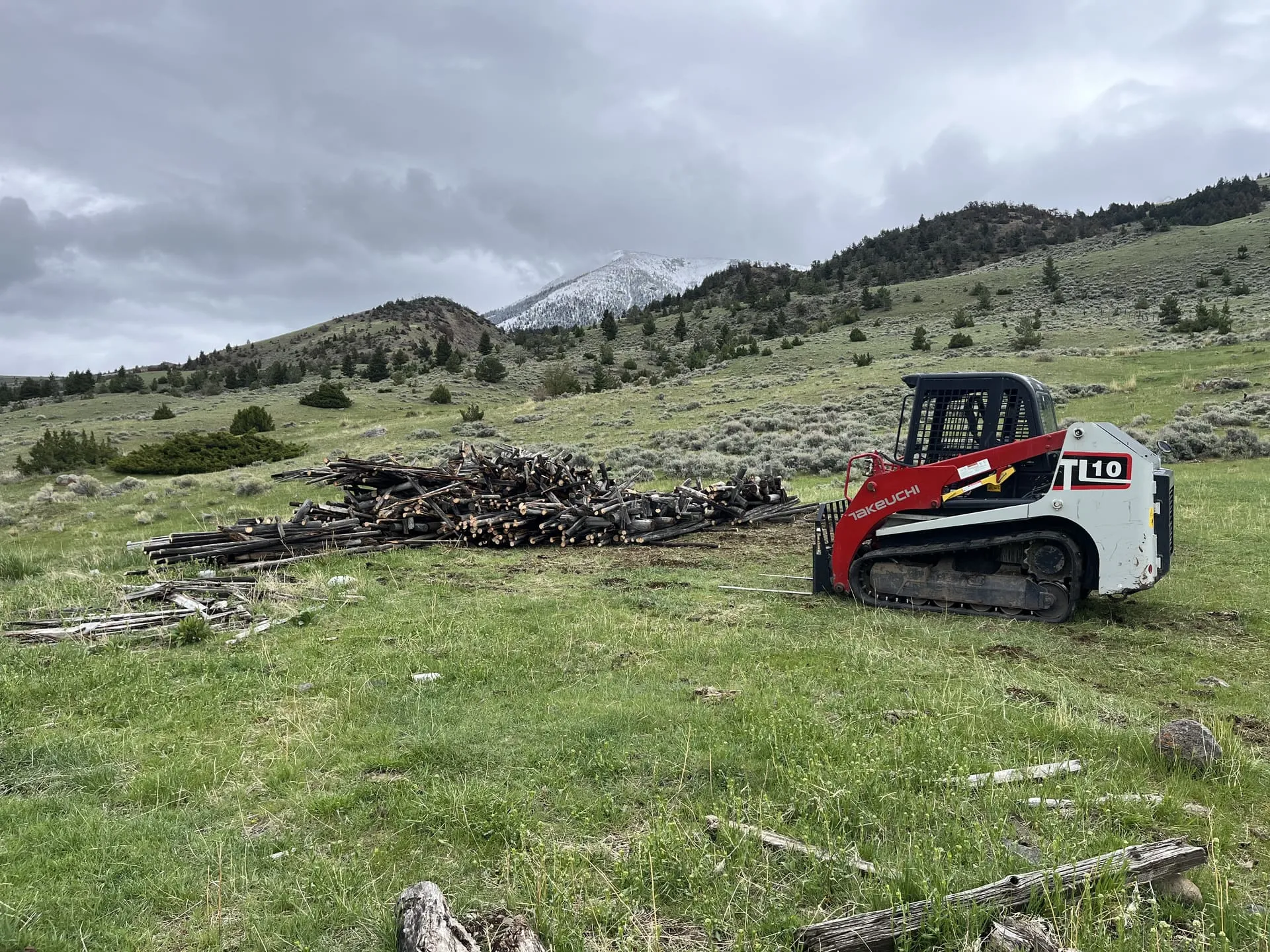 Old fence pulled and piled for haul-off before the replacement line goes in.
Are they honest about scheduling?
Fence work in Southwest Montana follows the ground. Frozen ground stops augers, wet springs keep machines off soft fields, and good-weather months fill early. A contractor who tells you plainly where your project sits in the calendar, and what conditions it needs, is more trustworthy than one who promises any date you want.
Our how we work page lays out how we handle the site walk, the written scope, scheduling and cleanup, if you want a reference point for comparing contractors.
Red flags
- A price over the phone with no site visit
- No written scope, or a scope that doesn’t name materials
- No license or exemption number they’ll share
- Vague about insurance, or unwilling to have the agent send a certificate
- A large cash deposit with no materials schedule
- Pressure to sign today
- No plan for rock, locates, boundaries or old fence
Before you call anyone
Get your own rough numbers first. Our guide on how to measure your property for a fence estimate walks through it, and the fence line measurer lets you trace runs, corners and gates on a map. We’re based in Bozeman, licensed and insured, and estimates and measurements are free. Call (406) 551-6772 when you’re ready to walk the line.